Wednesday, June 18, 2008

Perugia or Bust


Today we set off to explore Perugia. I told the brothers that part of being on a pilgrimage is to accept whatever happens as being part of the pilgrimage. I told them about how in the examples of other people on pilgrimage learned to think of all the good and difficult things that happened as part of the pilgrimage. A man bought us all coffees at the Assisi train station--a first espresso for most of us. This we reckoned as a blessing. We spent several chunks of time (I won't say how long) wandering around hoping to find where we were going: part of the pilgrimage. St. Francis was incarcerated in Perugia after the men of Assisi lost a battle to the men of Perugia. It was during his convalescence that he received his call (or rather it was during that period of his life he wandered over to San Damiano and prayed before the crucifix there). So Perugia is an important place to think about dreams of worldly glory and what God might do about them. We explored the churches and the museum, stopping to pray at a little church dedicated to St. Mary of the Light, a place built after a barber, losing badly at cards, swore profanely and a nearby statue of the Blessed Virgin reportedly closed her eyes in disapproval. She kept her eyes closed for four days. It is a very beautiful place to pray in, and we knelt there before the Blessed Sacrament. It is a great blessing to pray with other people.

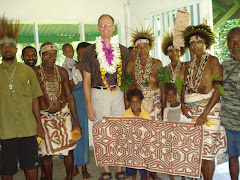
One of the things we have been talking about is how everywhere we go we meet people from all over the world. We were resting the other day near some nuns. I heard them speaking English and asked where they were from. A sister replied: "America, India and Germany." Br. Ezekiel commented: "St. Francis is for everybody!" Today we met an Englishman we'd met Sunday in Church in Assisi, and he very excitedly introduced us to his companions: "Three from Solomon Islands, one from Papua New Guinea and an American!"

One of the things I love about traveling with these brothers is their good humor in nearly all situations. They are especially playful. After visiting San 'Angelo Oratory we came out of the church to find two girls playing with their hula hoops. Their faces lit up with smiles and we immediately got them to have their picture taken with us.

Tuesday, June 17, 2008

Assisi Pilgrims

We made it to Assisi! Pictured above, from left to right are Br. Ezekiel Kelly, Br. Samson Amoni, Br. Worrick Marako and Br. Hartman Dena. They are from our pacific Islands Province, Worrick coming from Papua New Guinea, and the others from the Solomon Islands. We have been making a wonderful tour of all the holy places where St. Francis lived. Saturday we visited the Basilica of St. Francis. Sunday we went to San Damiano. Monday we trekked all the way out to La Portiuncula and back, and today we went up the mountain to the Carceri, the caves where Francis used to go to pray. Part of the fun is not only the devotion and interest in seeing places we have all read about and wondered about, but also the fascination with the wires carrying electricity, the underground parking garage. Here we are examining an olive tree, which they have only read of in the Bible. We are all taking turns cooking for each other; shopping is a laugh as we act out for the shop keepers what we want. As we walked up to the Carceri today, a nun coming down said there was only a kilometer to go (she was from Indiana) so the brothers all decided to sprint. We arrive, sweaty and laughing.
There seem to be a lot of beautiful statues of St. Francis to interact with.

Chapter Meeting


One of the ever-present aspects of my life is attending Chapter meetings. So far it has been about one a month. In my experience these are normally up-beat, positive events where the business of the order is transacted in each province. I have a voice and vote on every provincial Chapter. During the first week of June I attended the Chapter of the European Province. In addition to the Chapter meeting the European Province also has an All Brothers Meeting, so I got to see pretty nearly all of the brothers from the European Province. Br. Colin gave a wonderful lecture called "Rebuild My Church." In it he suggested 5 "strategies" for Franciscan life and work: to be humble; to invest our emotional and financial resources in community life; to seek to live in unity with each other as Franciscans and all other people and constituent parts of creation; to seek to live stable lives, rooted in prayer and care for all even when we live mendicant or itinerant lives; and to be accessible to others, seeking to show in simplicity and joy what it means to be a Franciscan.
Pictured at left are brothers Hugh and Philip Bartholomew, during the All Brothers Meeting. At right are Austen and Raymond Christian, waiting for Colin's lecture to begin.

Friday, May 30, 2008

Of Labyrinths and Sandwiches


I walked the outdoor labyrinth at Grace Cathedral , San Francisco, this week. It was a significant moment for me, as it was a priest on staff at this cathedral who pioneered the modern use of the labyrinth. It has been an important tool for me personally and for the brothers' ministry at Little Portion Friary where we built an enormous turf labyrinth that attracts hundreds of visitors. I think it was Rev. Lauren Artress of Grace Cathedral who first said that the labyrinth is an externalized archetype of life's journey. I often tell people my ministry as Minister General is a pilgrimage for me. Following the twisting paths I thought about all the different experiences I have had; trust and acceptance is the message I got from this important walk. I have to trust in the leading of the Holy Spirit (and the goodwill and love of the people around me: the world is full of grace and love!) and accept the struggles I have as part of my learning curve as I seek to live into the journey I am on.

It is weird taking your own picture, but there wasn't anybody around to snap it for me...

Fortunately most of the difficulties I face can be classified as "luxury" problems: scheduling flights, making meetings, solving problems and meeting publication deadlines. I was reminded that many people have much more basic and difficult problems, and I wonder how I would face them; the brothers in the San Francisco area are deeply involved in ministry with the hungry and homeless.
While I was staying with the brothers at St. Clare's House in Berkeley, we went out after dinner one night to distribute peanut butter and jelly sandwiches to the people on the streets. Some weren't interested in the sandwiches, but wanted to talk, others only wanted the sandwiches and to be left alone. Brothers Eric, Christopher Paul and Max share this ministry and at least two of them go out once a week. We met many people, some obviously looked out for the brothers and greeted them warmly. We all agreed that it might only be a band-aid to a huge social problem but getting out sure beat sitting around the house wondering what we could do to help. The experience forms a basis for reflection, and the conversations with people who are homeless or at risk on the streets challenge any prejudice we might have. I also think it gives authority to any advocacy work we will do in the future. I remember Dorothy Day writing about a young man who came to see her on his way to Washington DC where he'd landed a job that he expected would eradicate poverty. I think she felt a bit patronized by him as she showed him around the New York soup kitchen. After he left, she mused, "I wonder how many poor people he knows?"

Later in the week I went with Br. Simon to St. Anthony's Dining Room in the Tenderloin district of San Francisco. Simon volunteers there every Thursday, serving lunch. We were there from 10:30 until 1:30 and served over 2500 meals: gumbo, rice, green salad, bread, oranges and cake. I was really tired afterwards. The more experienced volunteers (there were about 15 volunteers and 10 staff) nodded knowingly, saying, "the first day can be real hard. Its kind of emotional." Indeed.

Friday, May 23, 2008

Corpus Christi Sermon

Preached at Church of the Advent, San Francisco

May 22, 2008


Thank you for the invitation to preach tonight. It is a great pleasure to be here. This is a marvelous parish. From 1982 until 1985 I worked at The Church of St. Mary the Virgin in New York City; I am not totally unfamiliar with the tradition of parishes like this! The Anglo-Catholic movement within the Episcopal Church has been all about celebrating the Holy Eucharist—often every day—and especially on Sunday, the Lord’s Day, with reverence. We celebrate Corpus Christi with great splendor as a day to pause and acknowledge the centrality of the Eucharist to our Christian life. We are also celebrating the 150th anniversary of beautiful, reverent, Eucharistic worship and social ministry in this parish.

The Scriptures for tonight highlight two aspects of sacramental worship that I believe are very important for us tonight. First, from Deuteronomy, is the statement that we depend on everything the Lord says. It is not just about food, but a deep sense of dependence on, and interdependence with, God. And the lesson for the Israelites is that when they depend on God, keeping close to the vision and mission he has set before them they will be given the Promised Land. It is not a sign of weakness to be dependent on God; it is an essential strength of an inner vision. Our Christian faith is clear that all that we do comes from God and we offer it back to God. The second scriptural aspect is that Jesus is the living bread, the source of our power, the One we come back to over and over. Everything we do here is to call us deeper into a relationship with God through Jesus Christ. Jesus is the source of our vitality—our food, if you will. In his book The New Friars Scott Bessenecker characterizes these qualities of dependence on God and relationship with Jesus Christ as they might look in the lives of men and women seeking to live them out. In his words, what we are talking about is Incarnational, devotional, missional and marginal.

As a Franciscan, I am reminded by our Principals (our Rule) that the Eucharist is the very center of our lives. (And I know it is part of your identity here) Brothers and sisters gather as often as possible to celebrate the Eucharist. In some of our houses there is no priest, so the brothers set the sacrament on the Altar for devotional prayer. You haven’t lived til you’ve knelt on the dirt floor of a palm thatched church at 6:00 a.m. sweating in the 85 degree heat, mosquitoes swarming around you, malaria, diarrhea, and prickly heat rash calling to mind your mortal nature, PRAYING the divine praises with 15 or 20 young brothers. I have to admit there was a tiny voice (clamorous actually) asking: “What am I doing?” I realized I had to answer that question for myself or I wouldn’t be able to persevere the whole half hour. What does it mean that the Eucharist is the center of my life when it is so inconvenient, or I feel so poorly, so weak and tired?

What it means is that God is fully present to me and all of us. The Eucharist is Jesus. Our celebration is about God’s transforming power and love dwelling among us. Incarnational. All that is ordinary (not to mention miserable) can be imbued with meaning touched by grace and that which we rebelled against can become sweet through our devotions (just like Francis and the lepers). I can be glib and facetious about physical discomfort in remote tropical friaries—but I am serious when I say those early morning devotions are sweet. Bread and wine changed by faith and grace into the Body and Blood of Jesus Christ. Ordinary elements, ordinary people, become instruments of God’s power: working for peace and offering a reconciling ministry in the world. Those Solomon Island Franciscan Brothers then went out from 1999 until 2002, between warring guerrilla bands, and together with the Melanesian Brotherhood over the course of many months meeting the militants for prayer and conversation, forced them to put their guns down. Then they poured salt water on the guns and holy water on the militants. Depend on God and great things can happen; Jesus’ death on the Cross can break open our hearts to love even our enemies. This is the source of so-called politics of meaning.

Our mission as Christians is chartered by our sacramental Eucharistic encounter. If the Eucharist is the center of our lives, Jesus Christ dwelling in us and we live in him, we have the power! We’ve got the power to forgive, to heal and to absorb the slings and arrows of the world, to shine light into the dark places, to tolerate misunderstandings, to make love the guiding and governing operative principal of our life and mission. We adore the Blessed Sacrament or celebrate the Holy Eucharist because these sacramental encounters create in us the open space God needs in order to incorporate us into the ministry of Jesus Christ. This is our Promised Land.

This idea of adoration and devotion is a real spiritual discipline. It is about cultivating in ourselves an inner disposition to see God in all situations, to let go of the sense of our own importance and ground ourselves in God’s will, God’s way shown to us in Jesus Christ. When Dorothy Day was asked how she managed to do so much and give so much of herself, she replied that when she was faced with a really hectic day she would take twice as much time in the morning meditating before the Blessed Sacrament.

It is significant that we celebrate the 150th Anniversary of this parish tonight: over a century and a half of transformative ministry in the heart of San Francisco. That is why the bishop and other church and civic leaders are here. The sacramental life and worship at Church of the Advent has given birth to many different initiatives on behalf of the poor, the lonely, the outcast in this city. By making your home in the City Center, you are making a strong statement about where the Gospel hope and values belong: in the gritty heart of the city.

Of course we in this parish don’t under-gird the city all by ourselves. It would be arrogant to think so. But in collaboration with other churches, people of other faiths and people of good will and courage and integrity like Harvey Milk whose bust is being unveiled this evening, the offering of the people in this parish is taken up and used by God in ways that I am sure you are not fully aware of. It is important to remember and reflect on this interdependence, it is one of the most important insights of the Scriptures for tonight and Christian sacramental theology (as Teilhard de Chardin teaches): the wheat and the grape, with human beings and God become the Body and Blood of Christ; the Body of Christ is the Earth itself, it is every human being, every living creature, the vitality of life. The Blood of Christ is the blood of martyrs, every wounded victim of war and crime and accidents, every drop of dew, every stream of water, the oceans themselves the Chalice cleansing and renewing the world through it’s many life forms. Through interconnectedness our smallness becomes one of the greatest gifts God has given us. Franciscans, at least, love marginality or minority, we call it. I think it is liberating: you can experiment with different ministries. Yeast is small, but the impact of its leavening power is great. You can innovate. You can work with different people to make a larger impact on the neighborhood. You live by different priorities than the world’s and bring love where it is most needed. Eucharistic spirituality is not disheartened by the seeming smallness of things. We know that it is in the hidden corners of the world that God was pleased to come among us—long ago and still today. It is usually that part of yourself you feel most conflicted about, where you feel the most marginal, there is the source of the most grace and blessing when you suddenly realize nothing is beyond the transforming love of God. The wheat and grape must first be crushed to become the stuff of the Sacred Elements.

Tonight we celebrate the Incarnation of Jesus Christ, devote ourselves to live in gratitude and thanksgiving for it, and pledge ourselves to go out into the world to seek out and serve the least, last, lost of Jesus brothers and sisters in the world: hall marks of Christian authenticity and optimism: what the world needs most, what people seeking Christian community long for most. The Eucharist is the way we relate to God and the world. Thank God for parishes like this that have consistently offered the means of grace we need to live the Gospel life.

Thursday, May 22, 2008

Vegan food in a Berkeley garret


The brothers have taken up residence in an old building in Berkeley, CA. They were short of bedrooms at San Damiano, so the Order of the Holy Cross is renting part of their old priory to SSF. Three of the brothers have moved there, and begun very creative ministries to students at the university and seminaries there. Our needs have outstripped our resources, and a lot of the conversation was about who had to go to San Francisco (it is a $7.00 trip), and how much food costs. Much of their food (mostly vegan I gather) is scrounged, "but perfectly fine" (they insist). We brainstormed ways to get involved with people in the area and to build relationships. Nobody is particularly worried about the lack of money (God will provide), though neither do they just sit around. The three who live there are full of chutzpah and enthusiasm. Br. Max has an old fashioned printing press, and he prints cards to sell; Br. Eric Michael works full time as a counselor (night shift) and Br. Christopher Paul serves several people as a spiritual director and hopes to find paid work as an adjunct professor. The brothers have asked me to move in with these guys, and so I brought my stuff from Little Portion in New York. The move was a sad thing for me, but I am now looking forward to being part of this edgy Franciscan scene. My travels are going to keep me away a lot of the time; I wont even unpack until Christmas.

While e-mail is still the best way to reach me, if you want to write me or support the brothers, the address there is:

St. Clare's House
1601 Oxford Street
Berkely, CA 94709

Sunday, May 18, 2008

The Earth is our Mother, we must take care of her.


Br. Cezar and I spent part of yesterday afternoon picking up the trash which gets thrown out of cars onto the side of the road passing along in front of Little Portion Friary. I see this trash when I go for my run in the mornings, and usually pick up several bottles on the way home. But there was an unusually large amount: we filled two bags. Mostly the trash seems to be liquor bottles: beer and vodka being the most popular. Plus empty cigarette packages and fast food containers. Cezar was surprised by the litter. "I thought we only had this in Sao Paulo" he told me. "It's everywhere!" I replied. I applaud the abolition of plastic bags in several places around the world. Picking up trash is a very small step in addressing the global environmental crisis, but it is necessary. I do not think it is possible to call oneself an environmental activist and ignore litter.
Trying not to fall into the trap of aggrieved self-righteousness picking up other people's rubbish, I noticed that the things which are worst for our bodies as any doctor will tell me, alcohol, tobacco and fast food are the things which people pitch out of their cars (are we feeling guilty, or simply oblivious to the additional damage to the environment?). Also these things can have a powerfully negative impact on the way we interact: drunkenness, secondhand smoke being obvious dangers.

Just as pollution and physical and social disease all seem to be interrelated, my time along the road on a warm, sunny spring afternoon, helped me to reflect on the beauty and interrelatedness of all creation: humans with plants, animals and the living organism of the earth. St. francis claimed kinship with all creation.