Wednesday, July 9, 2008

The Talk

This morning we had “the talk” with the Lambeth Chaplains. Over the past few weeks it had become increasingly clear to me that there was basic incomprehension among some of the chaplains about homosexuality. They were not familiar with the tem “gay” nor were they at all clear why the issue was controversial for the Anglican Communion. Richard Carter and Brother Sam did a brilliant job describing both sides of the issue. They particularly took time with the Scriptural arguments used by both sides in the controversy. The follow up questions were: “What do gay people look like?” “What do they do?” “Are they born that way, or do they choose it?” “Can people change and stop being gay?” Finally one asked the crucial question: “What does the Church teach about this?”

We were very careful to simply present the arguments and introduce some of the key vocabulary. We did not want them to think there was an “official” position of the Chaplaincy team; we stressed that we were committed to praying with and for everybody attending the conference and indeed to intercede for Anglicans and people everywhere. The members of the team from the Solomon Islands have been specifically invited to be Chaplains because they worked so effectively with the people of their own country when they were locked in civil conflict. Speaking about this experience, one of the sisters said, “We were free to pray with everybody because we were neutral.”

Is being neutral in this conflict the same as closing the closet door?

Obviously we can’t take sides in the Bishops’ discussions. We have to be open to meeting with everybody for prayer. Nor can we impute evil motives to people with whom we disagree. But I feel it is very important for gay Christians to speak up and be recognized. I was very uncomfortable when the chaplains were talking about “them.” Yet it is a long way to go from “What is gay?” to any kind of sympathetic conversation. Remarkably I did not detect any animosity or rejection. Bewilderment is the best term.

Actually “homosexuality” is not a problem for me, and patience may be the best tactic in service of greater acceptance than confrontation.

My experience in Melanesia is that there will be a time for conversation; today was only the first airing, the questions have only just begun.

Thursday, July 3, 2008

Building links of love


What is the life of a Minister General, Superior or Head Brother or Head Sister of an Anglican Religious Order like? Here we are, yesterday, weeding on a dull English morning. Sr. Catherine Rosa, Head Sister of the Sisters of Melanesia (on the right) and I have memories of digging a water supply trench in 1996 (in pouring rain and 90 degree heat) and preparations for many feasts involving cutting up pigs and chickens, chopping, grating, squeezing, baking food over roaring fires on all night cooking marathons. The Headquarters for the Sisters of Melanesia is next door to the Society of St. Francis training house in the Solomon Islands. Br George, Head Brother of the Melanesian Brotherhood (the largest Anglican religious order) and Br. Commins were also part of the weeding detail. The ulterior motive behind the work in the gardens is bonding and friendship. Our goal is to bring the group of Chaplains together into a working unit, demonstrating our Christian commitment and joy, to “be a praying heart” at the Conference. Sitting down in discussion is part of our time together on this 10 day preparatory retreat; we have daily Bible Study, and time for conversation. Yet these don’t quite get us over the hump of finding connection and solidarity since our cultural contexts make our statements virtually opaque. But questions surface as we work side by side. I think I know what we are talking about, then a brother will ask as we weed or shovel manure (today’s task): “What is homosexual?”

We are finding it hard to talk about these things, but we keep reaching across the cultural impasse as best as we can.

Obviously we are not being asked to lead the discussions at Lambeth, but we will lead much of the worship and offer prayers during the Eucharists, as well as offer a ministry of presence each day.

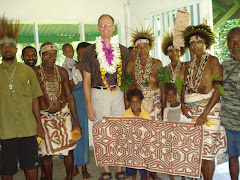
The brothers and sisters from the Church of Melanesia will be leading the Eucharist one day during the Conference, and they have sent an enormous box of traditional costumes and instruments. The box arrived today and we will begin serious rehearsals tomorrow, I think (all made it through customs, made of shells, wood, feathers and leather: who says miracles never happen!). At Mass today, the Hilfield Friary rang with the melodies of the South Pacific: ancient, polyphonic, fast paced.

Prayer, work, conversation, laughter and song: a humble recipe for gospel life.

Tuesday, July 1, 2008

Authority


There is much in the news about GAFCON and the gathering in Jerusalem. Many of those Bishops are expected to arrive in London today. The Archbishop of Canterbury has challenged the Bishops who participated in the conference. My heart sinks at the prospect of several weeks of trying to establish lines of authority and how to foster a sense of cohesion in the face of so many people with such strongly held views opposing each other.

Our visit to Rome last week made me think about the authority of the Pope and the claims of the Roman Catholic Church.

Francis was very clear about recognizing the authority of the Church, from the Lord Pope all the way down to the lowliest curate because of their connection with the celebration of the sacraments. There were other groups around in his days which advocated radical poverty and criticized the Church for her wealth. These people were persecuted as heretics. Francis, most emphatically, did not wish to be considered a heretic. But this did not stop Francis from speaking strongly to the Church about the beauty of poverty, the joy of the Gospel life and his desire to live it in the company of his brothers with the blessing of the Church. So Francis went to Rome to get the Pope’s approval of his Rule. After a first hearing the Pope sent Francis away; the next day he had Francis summoned because during the night he had a dream of a young man holding up a crumbling Church. He believed the man was Francis and gave his blessing for the Franciscan way of life. So Francis and his brothers walked a fine line: loyal to the Church while living according to their consciences which caused certain discomfort among the hierarchy.

To live the Gospel, simply and joyfully: this is the authoritative Franciscan ideal; our gift to the Church and challenge to ourselves.

There are real limits to the exercise of authority in any context. If people want to go their own way, they will. There can be negotiations about property, but it is hard to negotiate about beliefs. Francis resigned leadership of the order because he could not agree with the direction the brothers wanted to take it in. Not many years after his death the Franciscan Order began to splinter. In Assisi we encountered several groups of Friars: Conventuals, Capuchins, Order of Friars Minor, and Third Order Regular. We, as Anglicans, were perhaps the oddest of the lot! (From their point of view.) And yet the Franciscan ideal has survived, even flourished. In spite of their historical differences I kept seeing the brothers of different orders working together, sharing Assisi and keeping Francis’ memory and genius alive.

My challenge these next few weeks will be to honor the dignity of all that I meet and not sacrifice the integrity of my witness to love, compassion, joy, honesty. I don’t want to come home from Lambeth bearing permanent scars from hasty retorts and contemptuous thinking. Even if different groups have to go their separate ways, we can part as Christians, in a Christian way, or we can trash the whole Gospel enterprise and become a universal laughingstock mired in recrimination, hatred, intolerance.

Wednesday, June 25, 2008

Joy to the World


Monday we traveled to Greccio where Francis first re-created the manger scene in order to capture the hearts and imaginations of the people, helping them to see that Jesus was born as one of the people, and they are part of the story of Salvation.

The small cliff side friary was originally a cave, and we stopped and prayed in the small cave Francis used for that crib scene. Imagine a cow and a donkey crammed in here! Behind this cave is another which Francis and the first brothers used as a refectory/common room and behind that is the dormitory. Later, when Bonaventure was Minister General, he allowed the brothers to build a warmer wooden dormitory above this stone one, and it is called the Bonaventure dormitory. In a cave below the friary is the prison cell where John of Parma (another Minister General), who was suspected of harboring affection for heretics, was kept imprisoned over 40 years. The good news was that he wasn’t burned alive, and that he was eventually rehabilitated and brought up out of the hole and sent off on mission to Constantinople for the Pope (he died on the road coming home). By their cultural standards, the brothers dealt with him with tremendous compassion.

I was moved by the quirky enthusiasm of St. Francis, repelled by the abusive power which imprisoned a man in a cave. Church is such an amazing blend of good and bad. Obviously cultural standards are a source of great bewilderment. Living in an age when we are more aware of the vastly different cultural standards in the world today I hope I can always hold out for forbearance and compassion; rehabilitation and reconciliation are possible. Yet I wonder how long it will take? I’ve been thinking about Bob Dylan’s song:


How many roads must a man walk down
Before you call him a man?
Yes, 'n' how many seas must a white dove sail
Before she sleeps in the sand?
Yes, 'n' how many times must the cannon balls fly
Before they're forever banned?
The answer, my friend, is blowin' in the wind,
The answer is blowin' in the wind.

How many times must a man look up
Before he can see the sky?
Yes, 'n' how many ears must one man have
Before he can hear people cry?
Yes, 'n' how many deaths will it take till he knows
That too many people have died?
The answer, my friend, is blowin' in the wind,
The answer is blowin' in the wind.

How many years can a mountain exist
Before it's washed to the sea?
Yes, 'n' how many years can some people exist
Before they're allowed to be free?
Yes, 'n' how many times can a man turn his head,
Pretending he just doesn't see?
The answer, my friend, is blowin' in the wind,
The answer is blowin' in the wind.

Leaving Greccio we headed to Fonte Colombo (the “Mt. Sinai” of the Franciscan movement) where Francis composed the Rule of 1223. Here in a tiny cave where Francis used to fast and pray and write, we stood in a small cluster and renewed our Franciscan commitment: “Today we your sons renew and rededicate ourselves to the call you have given us. We renew and profess our commitment to a Gospel vision of life, handed onto us by our father, Francis, and our mother, Clare…” This is a Tau sign made by St. Francis.

The Power of Prayer


Sunday afternoon, June 22, we spent clambering around the Rocca Maggiore, the somewhat ruined castle that looms over Assisi. About the time of Francis the people stormed the castle and pulled parts of it down. Later it was restored, then fell into ruin and again restored! It has quite a history. We clambered over every square inch open to the public. Ezekiel (on the far left) is an expert hunter with bow and arrow, and he showed us how he would shoot from the windows of the castle if he’d been a soldier then. (Blow darts are his favorite weapon for hunting, however.) It was the view from the top of the tower that captivated us, because below the whole city of Assisi was visible, from Santa Chiara to San Francesco.

Later that evening we joined other religious orders in a long procession through the city celebrating “Festa del Voto” a religious/civic occasion celebrating how St. Clare saved Assisi from destruction by the Saracens. As her sisters prayed, Clare took up the Holy Eucharist and went to the door of San Damiano where the invading army was beginning to scale the walls. From San Damiano it is only two short kilometers to the city walls. Holding up the Blessed Sacrament she turned the invaders back. In gratitude the City of Assisi flowers to the tomb of St. Clare every June 22, the anniversary of the event and then takes a year’s supply of candles to San Damiano. We started in the piazza in front San Rufino then walked down the hill to City Hall. There we met the Mayor with a great fanfare of trumpets sounded by a cadre of men in red and blue tights. After the mayor joined the procession we went to the Basilica of St. Clare then, following the road outlined in small candles, to the city gate and down the slope to San Damiano. There after another fanfare the Bishop spoke and we knelt for the Benediction of the Blessed Sacrament. It was all very welcoming, nobody was turned back!

I’ve learned of another time when Assisi was saved from destruction by prayer. During WWII the German officer in charge of Assisi had the city categorized as a “hospital city” thus avoiding aerial attacks, then he willfully disobeyed orders to destroy the city as the German army retreated.

The city inspires love and admiration. I think it must be because the buildings are so closely associated with the narrative of Francis, and the radical call of prayer, love and service and joy. Just looking at the buildings and imagining the early Franciscan movement I feel that our homely efforts are not far off the mark.

Prayer works! No surprise ending here, but sometimes I need to remind myself; it has changed my life and the lives of many other people I know.

Saturday, June 21, 2008

And the Lord gave me Brothers


We walked 4.5 kilometers to Rivotorto outside Assisi, "because that's what Francis would do." We are having a very strenuous pilgrimage. But it was a glorious morning, bright, hot sun streaming down. We walked through fields of wheat and barley speckled with red poppies. Along the way we naturally started telling stories. Ezekiel told me about how he came to be a brother, his parent's initial opposition and how he applied to the brothers. He had been so impressed by a visit of three brothers to his village in the Reef Islands in the Solomons. Samson told of his first days in the order, he joined in 1979, and how life had been in Honiara sharing with white brothers and Melanesian brothers. He has become a teacher, establishing kindergarten schools and teaching in a small day school. Worrick comes from the Milne Bay Province of Papua New Guinea, he has served in most of the friaries in PNG. Hartman confessed to a wild past and that he left school early; nevertheless he managed the regional office and finances for several years. The Society of St. Francis has brothers from so many cultures and backgrounds. Rivertorto is where Francis first lived with brothers. As he said in his Testament: "And the Lord gave me brothers." Bernard, Giles, Peter, Sabbatino, Morico and others came to Francis in the tiny stone hut. Hunkered down in it I kept thinking it is a miracle those men could stand the situation, could stand each other because they were also very different men. Yet their life was remarkable for the love and respect and joy that all could see flourishing among them.. I have been told by several of our new brothers in the Province of the Americas that the reason they joined was because they saw incredibly different men living together with a minimum of tension and a lot of laughter and affection. It has always been a compelling thing, this thing we call community life.This is the Rivotoro.

Stigmata and La Verna

Thursday we went with Br. Daniel (second from left) to visit the place where St. Francis received the Stigmata. The wounds of Christ appeared in Francis' body in response to his prayer for a sign of God's favor; watch out what you pray for! But as we walked around the various places I kept thinking about how all the things in my life that I have found most painful have become the greatest source of blessing. One of the wounds I carry is alcoholism, yet in recovery I can say I am grateful. Gratitude is a big part of my prayer during this pilgrimage.

Francis used to seek out remote and uncomfortable places to pray. The crevice to the right is about ten degrees cooler than up by the church. Francis used to creep in under the cliff on the left hand side; the brothers keep a wood cross there. While I most prefer praying in my room in a chair, I found this place to be very powerful; what I suppose is called a "thin place" where the boundary between earth and heaven is very thin and permeable. The Franciscans say the cleft was created by an earth quake the day Christ died on the cross.

The Sanctuary is filled with della Robbia sculptures, and when we went into the small chapel of St. Mary of the Angels we saw an extraordinary depiction of Mary and the Angels. It happened while we were there a young friar was playing the organ, and the music was the theme music from "Brother Son, Sister Moon:" a great favorite of the brothers from the Solomon Islands. They've worn out their video copy and asked me to buy a DVD, which I will. We often sing the music as we walk around Assisi: "Brother Son, Sister Moon, I haven't seen you, seldom hear your tune, please to occupy the selfishness in me." Behind me is the view from the top of La Verna: hair-raising height but a fantastic sense of the hugeness of creation and the embrace of God.

After lunch we joined the Friars in the choir of the Sanctuary and walked in procession to the place where Francis received the Stigmata. It is now enshrined in a beautiful chapel. But every day for hundreds of years the brothers have gone to this place to pray, to give thanks and to dedicate themselves to serving the world in the name of the Crucified One.
On the wall of one of the buildings is this inscription: "Mount of secrets most holy and divine: St. Francis here with the wounds of Jesus marked, united his life with the sufferings of our Lord, streams of life now flow into all the world."