Thursday, December 11, 2008

Peace, Love and Architecture


Our desire to meet people notwithstanding, a large part of our itinerary involved looking at buildings: palaces, mosques, bridges, avenues. As much as I like these things I wondered: is this what we’re here for? To admire buildings while on a peace mission seemed a diversion.

But I soon was converted. The buildings were all about an ancient Persian/Islamic culture that is alive and well. I was reminded of John Keats: '"Beauty is truth, truth beauty," - that is all/Ye know on earth, and all ye need to know.' Islam has flowered in the most exquisite and delicate art; a people who could produce these things command respect.

I was intrigued to learn how they used the buildings, especially the mosques. Our guide obliged me and showed us the niche where the prayer leader stands, demonstrated the amazing acoustics which enabled people to hear without microphones (six hundred years ago). We marveled at the intricate designs of scriptural texts and the built-in time-keeping device that insured they always prayed at noon.

The buildings showed a longing for God, for transcendence. They are an outward sign of a powerful spirituality that emphasized (over and over): peace, hospitality, compassion, gratitude. The buildings, especially the mosques, reminded me of the Christian Churches I visited in Europe, which emphasized the same things.

Experiencing the people and the culture of Iran actually spoke louder to me than the fulminations of President Bush or President Ahmadinejad: the presidents say many things appealing to specific constituencies in their countries. It is a game! And we heard from people critical of the Iranian President, and we were free in our critique of ours. Yet polemics don’t heal. They are not creative vehicles for understanding. Moving us beyond polemics and political frustration, the beautiful buildings dedicated to God inspired poetic thoughts and nurtured audacious hopes for a new way of being human in our world.

The last night we were in Iran we were in Shiraz and we visited the tomb of the poet Hafez. He lived in the 13th Century (I think) and wrote deeply moving poetry. His tomb is an exquisite piece of architecture, yet the place is deeply holy because it is where young people come in the evenings to read poetry—to themselves and to each other. Couples meet and walk in the gardens. Some look flustered and walk silently; others were exhilarated by the chance to be with girls or boys, chattering with animation. Most people we met of every age could cite a favorite passage of poetry. Here was the real soul of Iran: the buildings hint at it, but in the voices of the young adults, I felt I heard it.

In the words of Hafez:

“When fair ones talk in Persian, the streams of life outwell:
this news to pious Pirs, my Saki, haste to tell”

Civilian Diplomacy


We were encouraged to go out and meet Iranians “on the street.” I’ve never been easy accosting people even to ask directions, let alone have a conversation about politics, religion or anything else. I was feeling a bit intimidated by the expectation that I’d have meaningful contacts on the street.

Yet I needn’t have worried. Everywhere we went people reached out to us and in my case, carried the conversational burden (in English!). A young army officer, a shop keeper, a student: they all began asking me where I was from. “America!?” they would respond in astonishment. One man observed: “After 30 years finally you have come.” Each was very anxious that I like their country. I could honestly say I liked it. It is beautiful. And the people are very friendly. Whatever I sad, it seemed to reassure them. Then they would peer up at me: “Please don’t bomb us!”

Invariably this comment left me feeling ashamed and angry. Would our US government betray our goodwill mission and attack Iran? Are my efforts simply naïve altruism?

Some might say so.

Yet except by meeting people, eating their food, walking their streets, how else are we to break down the dividing wall of suspicion that divides us? These people-to-people contacts are the only way to get behind the rhetoric we hear in America and they hear in Iran. Neither population is well served by the “party lines” we hear. Giving and receiving hospitality is at the core of our Abrahamic faiths. It creates a sense of bond and obligation which Christians, Jews and Muslims have scripturally understood to be sacred.

Another dynamic operating in these encounters is a cultural quality called ta’arouf. Hooman Majd in his book “The Ayatollah Begs to Differ” gives some very helpful insights. It means, in part, that nothing is too good for guests; effusive claims of love and friendship and exaggerated statements of humility are common (“I am your humble servant” might be answered with: “I am your devoted slave”). This Persian propensity for politeness and hospitality is given extra clout by the Koranic teachings of universal brotherhood and respect. It is very sincere, yet must be understood in context, which created some interesting learning moments for our delegation. If one has no idea about ta’arouf I expect there could be some baffling encounters. We were forewarned. But the first invitation to dinner by the proprietor of the corner newsstand as one buys a paper is astonishing. However, I found the few interactions I had, wary as I was, gave me a sense of a different culture, different manners, somehow highly evolved and beautiful. That appreciation didn’t exactly fill me with confidence that I knew what I was doing, but I could relax, clasp hands with the men and offer extravagant compliments in return: a tiny cultural bridge.

Tuesday, December 9, 2008

Overview of my trip to Iran

I returned on Sunday from an incredible trip to Iran. I went with The Fellowship of Reconciliation, a 95 year old organization committed to social justice through pacifism and interfaith dialogue. One of their principle tools has been the use of civilian diplomats, people like myself, who go and visit the country and then return to tell about their experiences. They have led delegations to many of the troubled places of the world. Local chapters are active in promoting peace in many countries.

Our delegation was the eighth to go to Iran with FOR. Our hosts were the Center for Inter-religious Dialogue within the Department of Education and Research. Only 300—500 Americans are permitted visas each year. We ended up being a delegation of 14 men and women, 10 Jewish and 4 Christian, ranging in age from roughly 25 to 80 years of age. It was the largest group of Jews to visit the country from America. This created an interesting and rich context for my own reflections on the group: rarely am I a religious minority!

We were definitely the guests of the government: I think enormous efforts were spent to be sure not only were we comfortable and well taken care of, but that we got a good grounding in Iranian/Persian culture, visiting Tehran, Qom, Isfahan, Persepolis and Shiraz. We met Ayatollah Bojnoordi, and visited the Jewish synagogues in Tehran and Shiraz (Iran is home to the world’s oldest Jewish communities, established over 2500 years ago); we met the Armenian Archbishop Sebouh Sarkissian, visited a Zoroastrian temple and spent most of a day with students and teachers at Mofid University discussing our different religious traditions.

Most of our discussions were fairly formal. There would be a round of welcoming statements and then each of us would introduce ourselves: name, institutional affiliation, home city and state. These were invariably followed by a presentation from the person we were visiting with an opportunity to ask questions. I had the awkward responsibility of representing Christianity: I kept emphasizing I only represent a small piece of it all, and that many disagree with me strongly. A great joy was meeting somebody in the hallway, or over lunch or perhaps in the street or park as we walked about. When they learned we were Americans, their astonishment soon gave way to one impassioned plea: “Don’t bomb us!” One contact that developed into an amazing encounter off the official itinerary was meeting Habib Ahmadzadeh, an independent film maker and to view his anti war film “Night Bus.”

In addition to meeting people and building relationships of trust and enhanced understanding, we were shown some of the most beautiful, extraordinary buildings: mosques, bridges, palaces, gardens, bazaars, the tombs of Xerxes, Cyrus the Great, and the astonishing ruins of Persepolis.

What did I learn? Nothing very abstract: it is a beautiful country; the people are very hospitable; they are great lovers of poetry. The food is delicious. Reflecting on our experience as “civilian diplomats” I think we were able to represent a slice of American society well: open, affectionate, and eager to make friends and communicate our message: No War With Iran.

Tuesday, November 25, 2008

Getting Ready to Go: Reality Check

Today I leave for Nyack, NY, to the headquarters of The Fellowship of Reconciliation for a short orientation before we leave for Iran Wednesday night. The past few days since my return from London Saturday have been busy; but the frosting on the cake was learning that UPS had not picked up my passport from the store I’d mailed from with overnight postage to get the visa. Learning this Monday, about 11:00 a.m., I rushed to the store and picked up the passport (forfeiting the $25.00 postage!). The challenge then was to find a way of getting the passport to the courier who would take it to Washington D.C. The man lives in Albany, I was in Port Jefferson, about 7 hours away. After several phone calls we decided I’d meet him in Nyack at 2:00. So I drove the 2+ hours to Nyack, getting there a quarter of an hour before the courier arrived!

Slouched in a chair in Nyack, resting, I learned that not every member of the delegation had received visas. The Iranians delayed until yesterday morning to issue visa numbers from Tehran, and they denied 4 members of our delegation; two others have not yet received numbers but indications are that they will in due course. What a shock! There is no apparent reason or pattern to the decision as the four include Jews and Muslims, male and female, experienced travelers to Iran, and first-timers. We may never learn; this is the way it is traveling to Iran.

This reality check will be the background to the work we do. I believe it will be important to let go of the anger and disappointment, and try to meet the people with open hearts and minds. Yet our governments are not in synch. They are suspicious of Americans and America is suspicious of Iran. The only way to dissolve the suspicion and the jostling for power is to talk, to reach across the divide and make relationships. Other delegations have made tremendous contacts, and the reports we read are that “ordinary” Iranians are enthusiastic about meeting Americans, dismayed by the nuclear competition.

Saturday, November 22, 2008

Preparing for Peace

I've been in London this week working on a proposal for a formation program which is intended for the brothers and sisters who will be working with our novices. It has been a great experience to work on this proposal: engaging in conversation with my colleague Sister Joyce, the Minister General of the Sisters of the Community of St. Francis, thinking, praying, and dreaming about the best way to empower our communities. I spent a happy day trolling the internet reading websites and seeing how what we hope to do might interface with what people are doing in the New York area. I came across a website with a program title: "Formators as transformative agents" by Don Bisson: this is exactly what we hope to be about! Not only do I hope the formators--the people who teach the novices--should be transformative agents, but all of us.

The other thing going on this week has been the increasingly intense preparations for my trip to Iran next Wednesday. I go as an agent of transformation, working for peace. In a way it is a chance to do the kind of thing Joyce and I have been talking about in terms of preparing the novices to do.

Sturggling to get over my jet lag I have had several weird hours of wakefulness, which I have used to read about Iran. My current late night primer is about the President of Iran: "Ahmadinejad: The Secret History of Iran's Radical Leader" by Kasra Naji. If ever there was a need to hear two sides of a story and to create bridges of friendship and understanding between two peoples, i think Iran is the perfect place to go. The language is so hyperbolic. So I have had to do some preparatory work thinking and praying about the best way to meet and relate with people in a culture and context very different from mine.

I am reminded of St. Francis and how he went among the Muslims. He went, refusing to preach much with words, but to live in such a way as to invite people to approach him with questions. I like this model of approachability, and hope I can present myself in that way.

I am in a hurry to get to Heathrow to catch a flight to New York. But as i go, i feel that it is all about peace, all about friendship, all about deeper understanding.

Monday, November 17, 2008

Trust

Yesterday I heard a great sermon by Phil Brochard, rector of All Souls Episcopal Church in Berkeley about trust. You can get a copy of it by e-mailing allsouls@allsoulsparish.org or maybe check their website: www.allsoulsparish.org I won’t re-hash it here, but it got me to thinking about whether or not I live trustfully. Do I trust myself? Do I trust the people I am traveling to Iran with? Do I trust my brothers?

Most of the time.

Another way of thinking about trust, for me, is to think about letting go. I have to let go of my fears, let go of my desire to control the outcomes of my interactions, and life transactions. I need to do my best and leave the rest up to God: trust God.

Sometimes trust gets a body blow: I got two of these last week.

The first challenge to trust was the destruction of the Order of Holy Cross Monastery in Santa Barbara. You never know when natural disaster will strike. My mind immediately starts to calculate risks. One can never be too safe; it is a thin line to cross over to “trust nobody” you are never totally safe. Of course I know life is a series of calculated risks, most of which we hardly acknowledge: crossing the road, driving on a free way, taking an airplane ride, which I do continuously without a second thought. Well, I have been having a lot of second thoughts since the fires in Santa Barbara.

The second blow was the report of the racist attack on a migrant worker on Long Island by a self-styled KKK group. They killed him, and left handbills threatening other “non-whites.” A friend attributes it to a backlash against Barack Obama’s election. To live trustfully in a democracy one must believe that people will obey laws and respect each other. Many of the migrant workers on Long Island are men and women I know. They catered the meal after my installation as Minister General last November. Racist attacks spoil the atmosphere of trust and harmony and weaken our society.

So I have taken these incidents as the starting place for my prayers each morning: affirming my trust in God, seeking to open my eyes to perceive the hand of God at work in the world around me. I try to notice the beauty of nature even as I recognize the fires are tragedies for my friends. I marvel at the many friends I have of every race and creed. Crucial for me is not to lapse into all-or-nothing thinking, taking a tragedy and replicating it everywhere in my imagination: “catastrophizing” as one friend calls it. Remembering these things clears my mind; I can sign a petition against racism, I can make calls and try to organize help for Santa Barbara. We are in solidarity with each other in good times and bad.

In God we trust.

Monday, October 27, 2008

Two New Provinces


I have been beyond the reach of electricity for much of the last six weeks: thanks for the concern some of you have expressed!

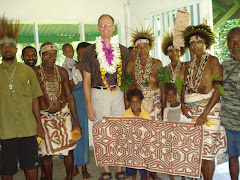
But it has been a really great time. I had to go to the Solomon Islands in September to preside at a special chapter for the drafting of Provincial Statutes and the election of a new Minister Provincial (see brothers celebrating at Hautambu at right); then I did the same in Papua New Guinea in October.

Frankly I was dreading the drafting of statutes. Whenever reference was made to statutes in the past I felt a sense of frustration, as if looking at statutes was the court of last appeal, a sign of imaginative failure. Here I was to be the prime mover in a writing exercise with a large group of men who rely more on an oral tradition, and by their own admission never felt the lack of a statute to be of any importance! What goes around comes around as they say… At left the PNG brothers prepare to write statutes!
But we plunged in nevertheless, willing to be obedient to the SSF Constitution. I quickly discovered that what we were doing was writing a story about their life in the province. Every rule rests on the collected memories of the brothers about things that have worked in the past, and of course the things that didn’t work. The areas of confusion and frustration in their common life got aired and we made a stab at giving direction to ourselves in areas like when there is a breakdown in relationships in the community.

Interestingly enough, the two hottest topics in both chapters were the age of admission and issues surrounding the uniform. Most of the life professed brothers in both provinces joined when they were teenagers, and are now in their thirties or older. But they had painful stories of other men who joined with them and then left. So we thought about making the earliest age quite old: thirty was the first age suggested by both groups! But then as we talked about it the age came down, to 22 (Solomon Islands) and 20 (Papua New Guinea). Determining an age is a bit of a shot in the dark anyhow: without birth certificates most brothers choose October 4 (St. Francis’ Day) as their birthdays when they get their passports, and memories are hazy as to the year, and usually tied to a significant event: a storm or death in the family. But all they need is a letter signed by two village members agreeing how old they are. Age we realized wasn’t the central issue, but rather readiness to test a vocation. They will never preempt the pain of beloved friends leaving community to get married or do other things.

Uniforms are worn in both provinces because it is too hot to wear the habit all of the time and there is a big need, culturally, for the members of the religious orders to be easily identifiable. Some wanted to do away with the uniform idea altogether, others wanted brothers to wear it all of the time. Again more stories, careful listening, choosing a way forward. Halfway through my first chapter, in the Solomon Islands, I was fascinated by the discussions. In neither case did the brothers speak eagerly. It seemed as if they were reluctant to speak or had no opinion. But I soon discovered that idea was only my own impatience. As facilitator I soon realized my job was to keep the discussion “open” until everybody had a chance to speak or indicated he didn’t want to speak. They spoke obliquely, not confronting each other. Yet they had quickly realized that much of the frustration they’d encountered in past years was because they had not had the opportunity to fully discuss these questions, and they had relied on a cultural model of the leader deciding all instead of the Franciscan model of the Chapter making the decisions.

These Chapters were an awakening for all of us. There was palpable relief as issues were brought up and discussed. Frequently brothers would say “I wish we’d known this when…” There grew a sense of power as chapter members, perhaps empowerment is a better word. All of us found ourselves talking about statutes during the coffee breaks with more energy than ever before in our lives. These brothers, the survivor Life Professed and leaders of the two new provinces, were able to tell of their love for each other and their way of life as friars.

It was an honor to talk about statutes with them.

The election of the ministers provincial had a certain amount of drama: singing the Veni creator spiritus in a woolen habit, kneeling on a graveled chapel floor during a tropical rainstorm made me think of certain scenes in the film The Mission. It took several ballots in both cases, and in neither case did the brother elected really expect it. George looked as if he’d been bitten by a snake, and I had had to convince Laurence (the outgoing Regional Minister) to change his travel plans because he’d wanted to go home quickly, thinking his time as leader was over. George recovered his usual poise quickly, and Laurence seemed more relaxed, perhaps deeply affirmed.

Anglican Melanesian Franciscanism: it’s a mouthful, it is a reality, and now it is written down.