Thursday, September 3, 2015

Friary handed over to Hope House Ministries

We had an emotional day today. We said farewell to Little Portion in a big liturgical service--over 80 folks came, our friends and supporters and those from Hope House. It was wonderful to see so many people, and we have firm intentions of staying in touch.


Sermon for Handing-over of Little Portion Friary
September 3, 2015
Br. Clark Berge, SSF

Good morning! We are at the moment of truth: the “handing over.” Today, Little Portion becomes home to Hope House Academy. I’d like to start us off this morning by singing together “Seek Ye First the Kingdom of God” as a round. [sing together]

The text for this song is from the Gospel chosen for today, and it captures the Christian vision shared by the friars and the De Montfort fathers. We are not to worry, to trust in God and to love as God loves us. It’s a tall order. But underlying it all is the knowledge that God provides for us in our comings and goings, in all that we do. This moment of coming together is unique. It is the perfect example of a liminal moment. We all occupy Little Portion Friary. So the proclamation of the Good News has to be shared by us all. The Occupy Movement has come to Old Post Road, Mount Sinai. So every time I raise my hand [like this] everybody say: “God provides.”

God provides us what we need. 86 years ago God provided the brothers with a home on Long Island through the generosity of the Sims family, the family of Brother Stephen. Through their hard work the brothers transformed a small cabin into a welcoming place of formation, hospitality and ministry to many people longing for God’s love. [God provides]

Father Joseph led a group of men determined to follow the radical example of St. Francis, to reignite the Franciscan life in the Episcopal Church after the Society of the Atonement’s pioneering efforts resulted in them becoming Roman Catholic. Fr. Joseph’s vision for the Order of the Poor Brethren of St. Francis of Assisi was about prayer, liturgy, teaching and proclamation among much more besides. Fr. Joseph’s work on the Anglican Missal was historic and claimed the Catholic heritage of the Episcopal Church, enriching the spirituality of many people. It was formative for our entire denomination. There is much that can be said about the conventual life of the brothers in those early days. They lived by their lights, full of faith and determination. Men came to join them as brothers. We are blessed still to have Br. Dunstan who lived here with Father Joseph, and Dominic and others who came and were part of that life. [God provides]

The brothers prayed, they shared their lives and reached out. In the 1960’s we joined up with, and became the American Province of The Society of St. Francis, the Franciscan movement grew in numbers and impact throughout the world. Yet it was a constant scramble to find ways to support the life financially. At the height of the Order’s membership in the United States, at the time of the Vietnam War, there were over 40 men. In the early 70’s somebody had the bright idea to bake bread. They applied to Trinity Church Wall Street and ovens were purchased, and all the other things needed for the bakery. [God provides]

In the early 80’s the brothers experimented with a less formal family life, moving out of these buildings to the guest houses of the Poor Clares of Reparation next door, down the hill. They became active in recovery ministry, and they reached out to parishes and institutions all over Long Island and beyond. Mary Haven took over these buildings for a school then administrative offices for their expanding work. A young priest with a vision for nurturing and supporting young men struggling in their lives started Hope House Ministries in the friar’s guest house, Wayside House. [God provides]

By 1991 the brothers were ready to come back up the hill. They re-imagined the use of the buildings, creating unprecedented access and welcome to guests in a Franciscan ministry of hospitality. In 1997, after a retreat in Missouri, I came home and we built the labyrinth. When Newsday published a full page photo of the labyrinth on the cover of Part II with an accompanying article, literally hundreds of people started to come to Little Portion. We were astounded by the spiritual hunger and need for loving community life. When we decided to have a labyrinth walk, potluck dinner and Taize prayer service on the night of the monthly full moon. We started having days of reflection: days of conversation, prayer, exploration, with wholesome food and a nourishing taste of the Sacrament for everybody. The friary bulged with people, we danced and we sang and we ate in the desert of modern consumerist culture of Long Island. People came home to God, to themselves, to their right minds here at Little Portion Friary [God provides].

Brothers fanned out from Little Portion. We taught all over the country, we served in different institutions: seminaries, universities, and schools; clinics, hospitals, and parishes. We opened our doors to migrant day laborers, gave love and money to them while the County Executive threatened to take away our tax exempt status for aiding and abetting illegal aliens and called us the lunatic religious fringe in a memorable statement to Newsday.

For these and all God’s many, many blessings, for the incredible life and ministry of the Society of St. Francis that continues to this day in this country and around the world, we give God most heartfelt thanks. [God provides]

But the world changes, as have our circumstances. What have we learned from the past 86 years? I want to mention three things out of 5000 that I could mention today.

First, nothing is forever. Impermanence is part of human life. Things change. This is not a curse or a setback. It is reality. [God provides]

Secondly our core values of love and compassion are transmutable. The friars are leaving these buildings (we’re staying on in the cemetery), but lives will continue be touched and transformed by God’s grace. The work of Hope House Ministries is exciting, it is necessary. If ever the notion that buildings have a soul made sense it is in the ongoing use of these buildings for the healing of lives, for the consecration of this property as a place of refuge and renewal. [God provides]

To say good-bye, to entrust the vision for this little piece of land and these buildings to others is absolutely necessary for our life and ministry as a community of Franciscans. The challenge before us is to embrace with courage whatever comes next. This “yes” to the future is the third great learning our sojourn on Long Island can teach us. As our brother Derek prepares himself for the next stage of his journey in Christ, we do too. It is not a failure or a defeat that we are acknowledging here today. It is the moment of Francis, stripped down naked in the public square before the astonished gaze of his family and neighbors. He handed his property to his father, saying “I no longer have a father here on earth, but only my Father Who art in heaven.” Nobody ever said God failed Francis. God’s power was demonstrated in the extraordinary letting go of Francis; Francis was empowered to give to the world a new vision of religious life through his trust. What better way do we have to help the church go deeper into the mystery of God’s love than to leap into those loving arms ourselves? How much more eloquently can we preach the joys of poverty and faith to a materialistic, power crazy world than to let it go ourselves? The friars are not becoming homeless, but we are moving on to God-knows-what, and countless numbers of young men seeking a new start in life, a place of compassion and challenge, have found a new home [God provides].

So it is with all of you, and all those who love us and care for us throughout the world (and who are remembering us in their prayers at this moment), we seek the deepest consolation of our faith and recall with sober joy the words that Jesus speaks to us and all who live and minister in the crossroads of the world: “. . . be concerned above everything else with the Kingdom of God and with what he requires of you, and he will provide you with all these other things.”

Yes, God does indeed provide. In Godly ways, with holy timing. Blessed be God.

These are the men who will be living at Hope House Academy at Little Portion Friary in the future, after necessary repairs and upgrades. Fr. Frank says they will be doing the work! They are singing "We never walk alone" if I remember right.


Wednesday, August 5, 2015

Visit to Papua New Guinea

I have been in Papua New Guinea from July 6 until August 4, a bare month. But what a month!

I started in Port Moresby, sharing the floor of St. Francis Church sacristy with Br. Oswald. He had fixed a pallet next to his with new sheets and mosquito net. The sacristy is a very narrow space: fortunately neither of us snore. What made it bearable was watching the construction of the new St. Francis School and parish mission house which is going up lickety-split, prefab structures on concrete slabs. The new construction is about 25 years overdue. I used to hate, hate, hate staying in the old mission house. We created a tiny friary, saying our offices hunkered on the floor, boiling the tea kettle on the floor between out beds for morning tea. Some youths who lived in an old classroom beneath Oswald’s sacristy built campfires to cook dinner, using construction rubbish. Dinners were huge, thank God.

I spent the days jogging, scrambling around Port Moresby with Oswald, gaping at all the frenzied construction that was going on in preparation for the Pacific XV Games—never mind they were half way through with the games! It’s going to be nice for residents of Port Moresby. But the rest of the country, as brothers and other pundits were saying still lacks very basic services, and these building projects for sports fill the hearts of a predominantly rural people longing for sanitation, education, healthcare with a deep ambivalence.

Then over the Stanley Range to Popondetta for Provincial Chapter. The Archbishop Clyde Igara, who is also the Provincial Bishop Protector gave a hard hitting workshop on leadership. Actually is was three hours straight of listening to him while sitting in very hard benches. But the brothers seemed riveted. Now we wait for the proof of the pudding…

The meetings were as meetings are: entertaining, dull, helpful, obstructionist, too long, not enough time. Normal meetings. The best part was being with the brothers and enjoying their humor and ways of being as men from Papua New Guinea. There is a bluntness in their conversation that leaves me breathless sometimes. During meeting breaks they all swarm about scavenging betel nuts to chew. I love the spicey smell, but not the red/black teeth. My AA sponsor long ago warned me off the stuff too because of the prized dizzy sensation and sudden loquaciousness.

My special pleasure was the cross country runs. I went several times. Once alone, and the following ties I was joined by some brothers and youths who are living in a Federal Detention Center located at the friary. Though it is surrounded by razor wire it is never locked that I could tell, the boys come to chapel, and meals with the brothers. Mostly they are 15-16 year olds who have gotten into fights after drinking or caught doing drugs, petty larceny. Remove the substances and the peer cliques and you have really nice boys! They latched onto me, and we all loved racing the roads. Once 8 of us went out, brothers lagging to the back to be sure the boys didn’t slip away, out numbers were swelled by several neighbor boys who came along.

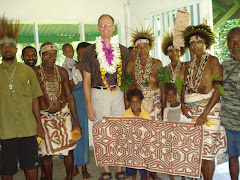
After Chapter I flew to Milne Bay Province, to Alotau. The brother’s friary is in a village called Ukaka, which is the name of a tree. We visited some Solomon Island Sisters of the Church studying evangelism at Hagita (which is the name of an enormous snake species that lives near there—I didn’t see one, thank God). We chattered away in Solomon Pijin, crunching the incredibly hard navy biscuits and drinking tea. I’ve known these two sisters, Phyllis and Agnes for nearly 20 years, so it was really old home week.

One day the brothers took me to a cultural day at Cameron High School. The students were grouped according to their province of origin, and they learned and performed the appropriate cultural customs of their local people. The day we visited they were enacting the rituals for presenting food offerings for a feast. These are strikingly varied. The brothers were all from Oro Province so we were sitting in the Oro shelter. Girls in tapa skirts and wraps, boys in tapa loincloths with kundu drums did the province proud with the Butterfly dance. I have been welcomed to the friary with this dance before, it is extraordinary. The poor pig shit himself when they hoisted it up on a stout pole to carry to the other side of the exhibition grounds with loud shouts and ululations. Then he got axed. Must have known it was coming.

The most electrifying performance was from the Manus people who were wearing bright read loin cloths (“Not traditional,” one Oro man sniped). I thought they were lovely. The boys marched onto the field with very large yams with which they did all kinds of lascivious things, thrusting their pelvis and pumping the yams up and down, held like footballs in front of them. I thought that took the cake for eye popping food sex. It was a great crowd pleaser. But then the crowd began to roar and laugh, and we all pressed against the police line that was trying to keep order. Several of the boys had emerged from a scrum wearing very long phalluses hanging from the fold of their red wraps, like the prominent stamens of the hibiscus flower. They had adorned the ends of these monsters with large cowry shells, and in ecstasy they whirled around flinging their appendages at each other, advancing on the crowd, grabbing each other. Adolescent heaven, and every single person there got the message about the life giving nature of the yam and its importance to the survival of the people.

Pigs squealed behind the dancers, suddenly there was extremely loud drumming and chicken carcasses were flung up into the air, the crowd started pressing harder together, then another pig got axed.

All this time rain slashed down, mud up to our ankles. These thousand year old customs protect something precious about community life, custom, survival and the power of art that is so missing from much of modern life. It sure trumped canapés and dinner parties!

Saturday, July 4, 2015

Core Trust

In his book "Daring to Trust" David Richo has written some very helpful, healing words:

"Core trust is trust in our life as it is as a trustworthy path to evolving in love, wisdom, and healing power. This is radical, nitty-gritty trust in bare-bones reality. Here our reliance is on the reliability of reality itself as right for us. This is because we trust it to grant us opportunities for growth and enlightened action.

Core trust, or surrendering to reality, is not only psychologically sane but also spiritually valuable. This follows when reality can be another word for the divine, the underlying evolutionary and sustaining force of the universe.

Core trust is an attitude of yes to the here-and-now predicaments of our lives as the perfect ingredients for building self-trust, increasing love, decreasing fear, and growing in wisdom and compassion. Our core trust is in how life unfolds, in the built-in synchronicity between events that come our way and opportunities for evolving. This means trusting that the universe may hurt but will not deliberately harm us. It may not satisfy, but it will fit our needs. Core trust means believing, with the same certainty with which we believe that the weather will change, that all that happens can ultimately be useful to our growth, can open paths on which we can advance in wisdom and love"(page 166-167).

In her characteristically earthy and cogent way my cousin said words much to the same effect after a serious set back in her life: "Another f**king growth opportunity!" I admire her for recognizing it!

It has taken me a while to get over the feeling of grievance and my personal pity party over recent set backs in my life. I have begun to think about the blessings of the move from Little Portion and the passing of my father though I'd give anything to reverse time and history on both events. I have a chance to re-locate somewhere as a result of the move, it is a call to wake up and shape my life more closely around my beliefs and values.

Dad's passing still makes my throat swell shut when I talk about it, but the hundreds of people who came to his funeral, the sweet times with my family and the stories we heard and shared over the past two weeks have revived my sense of joy in all that I shared with my Dad, and made what I share with close family and friends still all the more precious and beautiful.

Thursday, June 11, 2015

Lyme Regis

Last Saturday Br. John and I went to Lyme Regis for a free day during the siege of chapter meetings. It was terrific. We lolled on the beach, ate crab sandwiches. It was one of those beautiful clear sunny days that one never associates with England.

Obviously that's unfair because we have been blessed by really good weather all week.

The Chapter meetings went well, and now I am enjoying time at Hilfield friary. Next week I will be the Chaplain with the Poor Clares at Freeland.

During our visit to Lyme Regis, I was (as always) attracted to a book store. Posted in the window was "Poem of the Month" and it turned out to be "Invictus" by William Ernest Henley. This is the poem Nelson Mandela gave to the captain of the Springboks, which you may have seen in the film "Invictus."

I was really struck by the poem.

It's probably a bit over the top to compare the situation of change in my life to what Mr. Mandela endured or whatever miseries Henley was referencing. But the idea that we have power in whatever situation we find ourselves is very important to me. We have power to say "yes" to whatever life brings and know that we are the captain of our soul. The skill of finding something to be grateful for can change situations, can change lives. I asked the man in the book store for a copy of the poem, and he obliged with a smile. Apparently the author had his leg amputated by a surgeon from Lyme Regis. Here it is:

Invictus

Out of the night that covers me,
Black as the Pit from pole to pole,
I thank whatever gods may be
For my unconquerable soul.

In the fell clutch of circumstance
I have not winced nor cried aloud.
Under the bludgeonings of chance
My head is bloody, but unbowed.

Beyond this place of wrath and tears
Looms but the Horror of the shade,
And yet the menace of the years
Finds, and find, me unafraid.

It matters not how strait the gate,
How charged with punishments the scroll,
I am master of my fate:
I am captain of my soul.

Friday, May 22, 2015

“Omnia uno tempore agenda.” Julius Ceasar (Everything had to be done at once)


Well, now I am into it.

Rather: We are into it. The roller coaster of change is galumphing along some pretty dicey tracks, too, if you ask me. But this perception is very likely a projection of my own anxiety, as I am learning in my devotional reading.

Books have always been my friends, and during our Provincial Chapter meeting last week Chapter members were strongly encouraged to read two books. The first is William Bridges “Managing Transitions: Making the Most of Change.” So I downloaded the third edition to my Kindle and have been plowing through all the business jargon. Talk of managers, employees, products and competition is a bit dull for me, but it requires no big effort to see how patently necessary it is that we brothers read this book.

Bridges validates the confusion and chaotic feelings, the creative and sometimes desolating in-between times and offers good pointers about the new beginnings. I thought of this book tonight during Evening Prayer when the psalmist in Psalm 107 says “They cried to you in their trouble…” and later: “and you brought them to the harbor they were bound for.” A warm glow spread through my chest when I prayed this. It doesn’t say exactly which harbor—but they survived to sing about it.

During Chapter we were given several voyages to speculate about. Two brothers said their farewells to the Society; where will I be in three or four years’ time? Prospective homes for the friars were suggested: “Trust me,” the Bishop said. Some brothers have found places to live singly for the time being: there’s a choice to wonder about. And we heard about some men who are determined to come aboard and voyage with us, testing their vocations to this life: it makes the heart glad.

Bridges is generous in his book, giving readers different ways to get his message. I especially love the literary bon mots that pepper the text because they are at least from people I have heard of (i.e. not CEO’s of strange-sounding corporations). And these quotes express some of the contradictory feelings I have and which Bridges thus validates by including the statements in his book. This from Ogden Nash: “What I’d like is some nice dull monotony, if anyone’s gotony.” Amen. S.A. Tartakover, a Russian chess master speaking of the chess board at the beginning of a game: “The mistakes are all there waiting to be made.” But I suppose Anne Morrow Lindbergh lays down the law, so to speak, of managing transitions: “only in growth, reform and change, paradoxically enough, is true security to be found.”

We’ve got our Strategic Plan; we have all signed on to it and taken on what we must. So now the proof of the pudding will be in the tasting of it. We have to dig into this transition to discover another home in this world which is passing away.

We were treated to another book called “When the Past is Present” by David Richo, who gave us a day-long workshop on Letting Go (let the reader understand). Rarely have I read a book written just for me! I’ve already read it twice and am now marking my copy up, thirsty for its wisdom. It speaks to me of the need to be clear about who I am reacting/responding to—present reality or somebody/place from my past? The core discipline is practicing mindfulness, naming what I’m feeling, allowing all the feelings to be my teachers and letting them go. In all of this awareness one is strengthening their spiritual awareness of the beauty of the transitory nature of life.

Br. Jude, our Minister Provincial referenced the analyst Jung in his address to chapter: God is what comes across our path, causing confusion. So definitely this time is about God, defying expectations. It is a challenge and invitation to be open to all the things I’ve talked about so glibly before: prayer, patience, and mindfulness to name three! I feel invited to wrestle with the things I carry over from my past: family and childhood experiences. As David Richo says, “to wrestle respectfully as Jacob did with the angel, until it yields its blessing. The blessing is the revelation of what we missed or lost and the grace to grieve it rather than transfer it.” Transference is natural, everybody does it, and it can wreak havoc when it is freighted with pain and negativity.

God’s grace is always apt and abundant. Scripture should always be meaningful, but sometimes my attention wanders. Yet tonight I was touched. When I am feeling tender the Spirit is there helping me. In the Gospel lesson for Evening Prayer the Spirit said to the Church in Jesus’ defense to Martha of Mary’s engaged listening: “She has chosen the better part.” Amen. God give me ears to hear you!

Pray for us!

Saturday, May 9, 2015

Good-bye Little Portion


This week I left Little Portion Friary (pictured both in this post and as the new header for this blog). The brothers voted in September last year to sell the friary, and when word got out that it was for sale, Fr. Frank Pizzarelli of Hope House Ministries offered to buy it. It will be home to perhaps two dozen young men in recovery for addiction to alcohol and drugs. This wonderful ministry got its start in the guest house of Little Portion Friary 35 years ago. The brothers are retaining the graveyard, the county is negotiating for the forest, and Hope House will take over the buildings and use the property immediately around the friary. Fr. Frank has said he intends to keep the labyrinth open to the public, the outdoor chapel will remain, and the young men will be trained to bake bread so that the long tradition of fresh home made bread will be maintained. It is the happiest possible outcome short of an influx of 10 or 15 young men wanting to be friars...

I built this labyrinth in 1998, though it could have been a year earlier: memory fails me for precise details. We initially developed a practice of holding labyrinth walks on the night of the monthly full moons. A potluck meal started the evening, then the brief talk and orientation, people walked (or didn't, as they preferred) then a meditative Taize-style prayer service concluded the evening. We had some truly marvelous evenings. I remember the first time we were very concerned if there would be enough food, and indeed, the only thing people brought were cookies. We were pretty strung out on sugar. But after that, the beauty and diversity of foods was fabulous.

Over the years I have given innumerable talks about the labyrinth as a way to prepare people for walking it. Thinking about the labyrinth helps me to reconcile with the upheaval in my life right now. The first part of the walk, the walk into the center is an invitation to be present to what one is feeling. Good, or bad, it is good to allow the feelings to surface, acknowledge them--perhaps standing still and letting others walk past--before continuing on. I always found tripping along the outer edge the most desolating, memories of feeling far from the center or purpose of my life coming up for me. But turning in I'd remember happier times: the whole emotional gamut was often present for me. As I turned the corners of the labyrinth, I believe the turning would in someway stimulate my brain much in the way the brain is stimulated by EMDR. Deeper insights often came from walking the twisting path--walking itself is another way to stimulate the brain: left, right, left, right.

Finally I arrive in the center, the "liturgical" place for transformation, enlightenment, transfiguration. I say liturgical in quotes because the simile is inexact, but gets the point across I think. During Communion in the Holy Eucharist is the liturgical moment for connection with God, transformation, forgiveness, enlightenment, but often I don't feel any of those things. But once in a while I do. Whether I feel them or not I know at the heart and center of my life as a whole these things will take place. I believe everybody has such a moment in their life--but they are rarely engineered successfully. The moment arrives stealthily, like a thief in the night Jesus says.

Then comes the walk out, the "so what" walk. "What difference did this walk make in my life" That might be asking a lot of a labyrinth walk, especially if it is dark and disorienting, the food was gone or you feel sand bagged by too much information from without or within. But taking 20 minutes for yourself to be present to your feelings and to be open to a larger connection can perhaps be all that is needed to have enough clarity to relax a little bit. Or to realize you need to apologize to somebody. Or to remember their is more to life than rushing to the next thing. Maybe it is just being outside in the muggy evening, or the mist and rain, the frost glinting in the moonlight that reminds you or your creatureliness.

So I am trudging on my life path, feeling very grateful for the last 25 years at Little Portion, and very sad about leaving; I feel happy and grateful for the future for the place and wondering what is in store for me and my brothers. But the essential sense of connection with God, the awareness of connection with other people and the earth--that place in Mount Sinai as well as so many other places around the globe where I have put down roots--remains with me. To assess the past 25 years, the "So what" I have to acknowledge the huge impact of my brothers on my life, the gift of sobriety which is a big part of my story in building the labyrinth, in using it, and in my ministry and life as a whole.

The labyrinth has been a way to enlarge my sense of life, I have experienced wholeness, healing, freedom in connection with it. So now I take these things, which can never be taken away, and apply them to where I am now. I am not diminished by the loss, I am not homeless either.

The name of this blog is "The World is my Friary" an adaptation of St. Francis' statement that the world is his cloister. Francis was forced to move on from Rivo Torto and lived an itinerant life, often a mendicant one. The dependence on the generosity of others and the abundant grace of God kept Francis growing and deepening. What some thought of setbacks he praised God for poverty, chastity, even hunger and tiredness because in all things he came to know the way of Jesus Christ and the abundance of God love for all creation revealed in the life, death and resurrection of Jesus Christ.

So I need to walk my talk: depend on God, be open to the prompting of the Spirit, seek ever widening circles of freedom, generosity, love and compassion. I often just pray to be kinder and more patient! Where the journey will end, where I will finally unpack my seven boxes of memory drenched trinkets, books and fraying clothes I don't know (they are in storage for now, and I am exulting in the freedom of 4 shirts, one pair of jeans and one pair of shorts!).

I also believe that the Church is facing a paradigm shift, we are seeing he emergence of new forms of worship, new kinds of community life, both religious orders and parish types. Paradigm shifts sound beautiful and easy, and perhaps a bit abstract. But they are painful as hell, and living in between the grinding stones may provide substance for the future, but I wouldn't seek it out. Obviously God is behind it, making all things new, whether we participate reluctantly or enthusiastically. Its my decision if I make myself miserable with all of this or not, and I am choosing the joy. I have so much to be grateful for, so much to look forward to: the world is indeed my friary and my home.

Sunday, April 5, 2015

Happy Easter: Don't Be Afraid!

Homily for Easter 2015
Hermitage of St. Bernardine
Stroud, NSW, Australia
Br. Clark Berge

“Don’t be afraid!” This is the counsel we get in Matthew’s Gospel in the light of the Resurrection. Fear clouds our thinking, diminishes our generosity and inhibits joy. I was set to preach on this after our meeting last week, then doubly so after reading Tim Winton’s speech Bruce forwarded me from the Palm Sunday walk in Perth about the Australian response to immigrants. (http://www.theage.com.au/comment/tim-wintons-palm-sunday-plea-start-the-soulsearching-australia-20150329-1ma5so.html) Fear is all around though we don’t always name it thus. Easter morning is a good time to weigh our fears, and to look at them in the brilliant light of what we believe God is doing in the world.

During this liturgy we are given numerous images of God and we hear stories of how God acts in the world: lovingly and creatively in creation, in the nick of time in the story of Abraham and Isaac, salvifically at the Red Sea, compassionately in the prophecy of Isaiah, and refreshingly with sprinkled clean water in Ezekiel. We believe God acts in loving, timely, saving, compassionate new ways; yes? All of this is released again in a startling way in the story of the Resurrection. Our beliefs about and our images of God control our actions, so we have our charter.

But what can dissuade us? Reluctance to confront others, busy-ness or preoccupation with other matters, sometimes we say we had no idea what was wrong. Offering ignorance as our defence is pretty shaky! But we offer it out of fear of being accused of callousness. I think fear lurks in the depths of all these defences.

Tim Winton spoke powerfully about the corrosive fear that has diminished Australia’s response to immigrants, and he called on his fellow citizens to shake off their fear.

America, to be even-handed, struggles with a fear of difference too: racism is alive and well in my country. Why else are 90% of inmates black? Why else do young black Americans walk in fear through the city streets? Fear twitches the fingers of the trigger happy. Where is the generosity, creativity, loving, saving compassion in deporting children to countries virtually foreign to them?

Bringing it closer to home, do fears make us friars not speak honestly to each other? Does fear make us flip into angry attacks rather than loving, honest exchanges? Why do I get so defensive when I feel criticized—even if nobody has said anything? As Winton describes Christians: we’re “lily livered” followers! When I got sober in 1999 I had to do an inventory of my life, step four of the 12 Steps of Recovery. Not only do you list what you did, but you need to say why you did it. Over and over again, I found myself saying, “I was afraid of what people would think.” “I was afraid he was trying to take something away from me.” “I was afraid I’d be left out.” I was afraid, afraid, and afraid. Just telling people “Stop it!” doesn’t actually change lives. It is a good consciousness raiser. It makes marvellous rhetoric at a public event. But what has helped me most is being loved. When I hear people laugh at my horror stories, and then share their own, I know I am loved and accepted. When I feel ashamed, I am often reminded I may have done something wrong but I am still a beloved friend or brother. As fear has diminished I have grown. Or, another way of saying it, as my self-preoccupation has died, Christ has grown in me. But if I live to be a 110, I may always get a knot in my stomach, may always feel a flash of fear, my old weakness. But by then I will perhaps banish it with the intake of a breath, and “know intuitively how to handle the situation.”

Fear can ruin our personal lives, thwart our highest aspirations as we sometimes seek to dull the effects with alcohol, or sex, or work…you name it. Fear can pervert our community and our countries. A world in the grip of fear can only pay lip service to new life. Fear is perhaps the only thing that could undo Jesus’ ministry and render his death meaningless. Demagogues always build on fear, it is second only to love as a great motivator.

God did what only God could do; he broke down the barrier of death, classically the greatest human fear. The only thing we have left to fear is fear itself, as Franklin Delano Roosevelt famously reminded Americans at his first inauguration. You see we aren’t the first or the only ones to struggle with this.

“Don’t be afraid,” the resurrected Christ implores us. “Don’t be afraid.” Thus even at the grave our victory shout rings out: alleluia, alleluia, alleluia.


I preached this at the friary chapel in Stroud: 4:30 a.m. Easter morning! I arrived in Australia on Tuesday night last week from the Solomon Islands; I attended their chapter, then gave a series of three lectures/workshops to 30+ brothers and wanna-be brothers, and finished my visit preaching at St. Francis church in Honiara, preaching to over 500 people. It wasn't all work though. I got in some great work-outs, nice long runs through the jungle on dirt tracks, and march 25 we had a beautiful Eucharist in the morning and then off to the beach for one of the nicest picnics: tinned plums were the highlight until the brothers caught some octopusses (octopi?) which we grilled: very tasty. A wonderful time.