Sunday, April 20, 2008

Brisbane, Australia and Hamilton, New Zealand


The Brothers in Brisbane entertained at a nursing home Sunday April 13. Pictured here from left to right: Br. Wade, a novice and fabulous singer, Br. Nathan-James who is a nurse and seminarian (and good singer too), and Br. Gabriel Maelasi, a Solomon Islander studying anthropology at the University of Queensland, where he also serves as a volunteer chaplain. Not pictured (because he was standing too far to the left) is Br. Lionel. (Okay, they are all good singers, which is why they are part of a choir...I don't mean to leave anybody out or infer judgments on their singing ability!) Lionel is looking forward to returning to his native Sri Lanka to set up an interfaith ashram. The other singers pictured are parishioners at St. Philip's Anglican Church which the brothers run in Brisbane. There are eight brothers at this friary, making it the largest house in this province. They also serve as doctors and nurses, teachers, they work with homeless and serve on boards for various institutions: a very well rounded, active group of brothers. I spent several days going around with them individually.

On April 15 I flew to Auckland, New Zealand, unaware that it is nearly two hours drive south to Hamilton, which has an airport too. We made it safely, and Wednesday morning I was given an official Maori "powhiri" or welcome. Hamilton is governed under a treaty signed during the reign of Queen Victoria according to which the pakeha (white) and Maori people cooperate. My arrival was an event for the whole community. My impression is that it was not about me, but about the deep and enduring affection for the Franciscan brothers living in this village. First a conch shell was blown by a young man in a feather decorated tunic, calling the people together. The Maori and other residents of the village stood inside a defined space, and I stood outside, accompanied by the Archbishop of New Zealand and several other Franciscan Tertiaries and friends who had come to Hamilton to meet me. Then another young man dressed as a warrior (that is to say with a leaf breech cloth) and wielding a very long club or spear danced the length of the ceremonial space. After several threatening moves, he cast a wooden dart on the ground before me and backed off, holding my gaze with his eyes and a stern frown. He held the spear at the ready. "Pick up the dart with your LEFT hand," the Archbishop instructed me. "your right hand means trouble!" Once I did this, a woman began singing a very beautiful song, and she was answered by the others in a call and response. Everyone was dressed in black signifying great formality. Apparently very few visitors are challenged with the dart, they only do this ritual for visitors judged to be very important. Finally the Archbishop and the young warriors guided me into the community house as everyone filed in singing. I was not permitted to take photos because the young men are part of a community based program for young offenders and their identities are protected.

Once inside the community house we heard six speeches. Mine was the only one in English. The entire event was conducted in Maori. I was impressed that all of the other pakehas (white people) understood Maori. Archbishop David Moxen whispered in my ear the gist of what each person was saying: all of them were putting my visit into context for the community, and showering praise on the Society of St. Francis. I was incredibly proud of my brothers for their long-standing and faithful ministry in New Zealand. After each speech (speeches were given by the men) members of the community, led by the women, would stand and sing a song to support the speaker.

When it was my turn to speak I spoke of my joy and gratitude for the welcome, and tried to put my ministry into the Franciscan and Gospel context, recognizing kinship with all people and the earth, praying for greater connection with indigenous peoples as we seek to discover new ways of being human on this fragile island home of ours. The Archbishop and others then surrounded me and started singing "Praise God from whom all blessings flow..." and the Maori's all sprang to their feet and joined in. It was a moment of joyful gratitude.

Concluding our ceremony I went to each man in the room and rested my forehead against his, and pressed my nose to his nose. We each breathed in and out, then I passed on to the next person. Behind me the other visitors lined up to do the same. The symbolism is that now we share the same breath, breathe the same air: we are connected. The women preferred air kissing and touching cheeks. Later it occurred to me perhaps I wasn't supposed to be so intimate with them and they were trying to cover my cultural gaffe. At any rate it was a profound experience of connection and grace.

But this wasn't all. There then followed a huge meal in another room, with more singing and speeches. What a beautiful welcome and affirmation of the Franciscan ministry here.

Wednesday, April 16, 2008

Mud bricks and Ministry


This place is pure poetry. It is called the Hermitage of St. Bernadine of Siena, located in Stroud, NSW, Australia. I came here for the Provincial chapter meeting March 28-April 2. the meetings were useful and interesting, as such meetings go. but what was really great is this place: built in 1980 by dozens of volunteers is is constructed of thousands of hand made mud bricks. The site itself was slated to be a garbage dump on the edge of town, but the brothers and sisters were able to re-claim it. The moved onto a bare, rubbish-strewn, treeless site and began making bricks. The dedication attracted thousands of people. It is the kind of place that really grabs my imagination. Think of it as a metaphor for the Franciscan life: inhabiting unwanted areas and making them lovely, turning mud into beautiful homes, living in and on and with the earth. The brothers who live here offer the place for retreats and quiet days, for groups, but mostly for individuals looking to get away. St. Francis depended on regular times of retreat and withdrawal in the wilderness, living in caves and wandering in the forests.
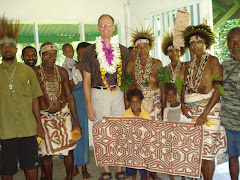
Pictured at the right are some of the pioneers who built the Hermitage. From left to right: Br. Brian, Isabel, Trevor, Br. Bruce-Paul,Gwen, Alfed BoonKong. In front Br. Joseph (he is a novice and wasn't a brother in 1980).

Monday, April 14, 2008

Arrival in Papua New Guinea

I had a real shock when I went to Henderson Airport in Solomon Islands. I'd been upgraded to first class! I got a taste of the high life...

Arriving in Port Moresby, I was met by Br. Laurence Hauje, the Regional Minister, and he took me to St. Francis, Koki. This site is where the friars first settled when they went to Papua New Guinea 49 years ago. I had a strong sense of the first Friars coming from England and building the rather extensive parish church and school campus. SSF only lived there about 10 years, and the parish was taken over by the diocese. Unfortunately precious little maintenance has been done in the last 50 years, so the buildings are in deplorable shape. Nevertheless the students from St. Francis do exceptionally well and many of the leaders of modern PNG were students at this school. About 10 years ago Br. Clifton Henry became the parish priest and the brothers returned to the parish. although the current priest is not a brother, the friars work in the parish and offer RE classes at the school.

Each morning the students gather for their morning assembly, which includes singing the school song and the Papua New Guinea national anthem.

After just a few days at Koki, I flew over the mountains to the eastern side of the peninsula to Oro Province (the first posting on this blog describes the "Disaster" which destroyed the infrastructure of the province).


The brothers arranged for a welcome for me, including several local SSF Companions and Tertiaries. The friary at Haruro is in many ways the "Mother House"of SSF work in the Pacific. Today the friary is the training house for the region, and the postulants and novices begin their time with us there. They have lectures and workshops in the morning and in the afternoon they work in the gardens, raising food.

Friday night I went to Newton Theological College where I spent a wonderful evening with Br. Oswald and Br. Selwyn Suma who are studying for ordination. Some of the other single men joined us for sandwiches and pineapple slices, and we had lively conversation about their studies and the work they hoped to do in the future as franciscan priests.

On Monday March 10 we traveled to Katerada, so could spend the night with the brothers there. I had neglected to charge my camera battery, so I have no photos of it, but the brothers have an extraordinary ministry of hospitality to the people displaced by the November flooding. Five families live with the brothers in the friary, and the parish priest lives with his family in the garden gazebo/rest house. Meals are a community effort, and we said the offices sitting outside on chairs so as not to disturb the babies sleeping. Every day the brothers work with the refugees, visit people in the local health clinic as well as visiting parishes in the larger area. In addition to providing emergency housing during the crisis, the brothers gave away huge amounts of food.

I returned from Katerada Tuesday afternoon.
That night one of the novices, Br. Allan, (at right) went out hunting for a pig for my farewell dinner, and as luck would have it he speared a pig caught rummaging around in their sweet potato patch. His cry brought all the brothers running and they helped prepare the pig. I didn't hear the cry, or didn't distinguish it among all the many strange sounds at night. I only learned about the hunt the next day.

Wednesday morning, Br. Wallace, the Guardian, took me on a local transport to Martyr's School where Brother Robert and Brother Anthony are school Chaplains. We had to travel on the back of a large truck because most of the bridges are out and we had to drive through the rivers.Martyr's School was one of the first Anglican schools in PNG, built after WWII, and named after the men and women (all were missionaries, both nationals and ex-pats) who were held captive and then killed with bayonets by the Japanese. Because of the devastation caused by the floods, the school term was only just beginning, nearly five weeks late. As Chaplains, the brothers teach religion courses and re available for counseling with the students. Many of the brothers have done this job, and as we traveled around PNG in the next few weeks, we were often greeted by young adults who had been students at Martyr's School.

The farewell dinner featured the delicious pig and dozens of other dishes prepared by the brothers and their friends. It was a happy time with gifts, speeches and singing.

Friday March 14 we flew to Alotau, to Ukaka Village to receive the First Profession of Vows by Br. Dudley Adia and Brother Gabriel on Palm Sunday. The weekend was spent gathering stones for the ovens (called muu-muus in this part of PNG), killing the pig, gathering coconuts and other provisions. Finally the big day arrived. It was the first time I'd received brothers' vows and it was a big deal! They were trembling and stammering as they said their vows. I was a basket case myself; bless their hearts. It was a relief to come out of church to a huge picnic feast. The brothers' families danced and sang, and tray after tray of food was brought out; Brother Dudley's family and many friends and neighbors had stayed up all night cooking.

We returned to Port Moresby for Holy Week. We all shared in the parish observances, many of us speaking at the Good Friday Stations of the Cross, clambering all over the stony hillside behind the church. Nearly 80 people clawed their way along the route, slipping and sliding: no easy path following the Way of the Cross. Easter Sunday I preached at the parish Eucharist. Brother Lukas (at left) and 6 other young people, served as acolytes wearing traditional costumes. The words were pretty much the same as we use in the Episcopal Church, but we were definitely not in Kansas any more!!

Easter Monday Br. Laurence and I flew to Goroka in the Highlands so I could meet and spend time with Br. Andrew (below, with his cat). Andrew was with the first brothers who came to PNG in 1959 and he has had a remarkable career with the brothers. He became a psychiatrist and for many years worked with the government. He was also part of the Melanesian Institute and wrote and taught on cross cultural work. Currently he does mostly forensic psychiatry, interviewing people for the public defender and writing reports for the courts. It is still pioneering work in that country and he has brought a tremendous amount of compassion and mercy into the proceedings for many people.

Wednesday, April 2, 2008


Six o'clock in the morning, waiting with Br. Athanasius for Solomon Express to be ready for passengers for my trip to Malaita Island, February 5.


Ash Wednesday 2008: Standing with Br. Noel Nikki at the entrance to the Malu'u Nurse aide Training School on Malaita Island, Solomon Islands. He will finish his program at the end of May and then work in a clinic. Mostly, he says, he deals with malaria, STD's and knife cuts. Franciscans have been involved in nursing for over 800 years. Nurses are urgently needed in the Solomon Islands: they are 129 on the UN Humann Development Index.


The Foua'ala School for Girls, founded by Br. Colin. With a small grant, Br. Colin and the people of the village of Foua'ala have been building the school for several years. Each piece of metal roofing, every bag of cement and box of nails must be carried up a steep mountainside. The timbers are cut by chainsaw on site in the bush where the trees are felled.


A student of the St. Francis Kindergarten School at Vuru, Guadalcanal. It is located next door to the Michael Davis Friary east of Honiara, where I celebrated Mass the First Sunday in Lent. One of many "kindy's" founded by Br. Samson Amoni, the brothers of the Solomon Islands have worked to provide early childhood education. They are in need of every imaginable resource except loving and enthusiastic teachers. Several of Br. Samson's schools have become well established. This school is only one year old.


The Brothers at Patteson House, in Honiara, the capital city of the Solomon Islands provide a refuge for many people visiting town. This boy, Samson, lives in the friary with his father. His father sells betel nut in the Central Market. Hundreds of people visit Patteson House every day asking for cool water to drink, a toilet to use, a place to sit and rest in the shade. At night up to 12 roll out mats to sleep on the floor, some on a semi-permanent basis, others only for a night or two as they await transport (usually a ship) to their home villages.


All hands on deck to help make the coconut/cassava pudding which is a celebratory mainstay in the Solomon Islands. We grated dozens of coconuts and a hundred pounds of cassava root to make a large pudding for the welcome dinner for the 2008 Regional Chapter. My gloves caused great hilarity among the brothers but prevented me from getting blisters.


While some brothers prepared the pudding, others prepared the kitchen ovens where the pudding was cooked under hot stones.


After a week of Chapter meetings, we held a closing feast, and Br. Laurence Hauje, the Regional Minister for Papua New Guinea and I were presented with beautiful necklaces.

Wednesday, February 27, 2008

Laef blong Solomons

I am still puzzling out why I can't upload pictures from this internet cafe in Honiara, but I guess you'll just have to wait until I get to another country! Lots of great photos, friends!

"Laef blong Solomons" is Solomon Islands pijin for "Life in the Solomon Islands."

February 15 I traveled out to our training house on West Guadalcanal, called Hautambu. 45 Franciscan brothers gathered there for the regional chapter. My arrival as Minister General was celebrated with a "warrior's welcome." This welcome means 12 men wearing loin cloths and body paint, brandishing axes, spears and knives leaped out of the undergrowth shouting in their native languages. My attention had been distracted by a comment from the driver of the truck so I didn't see the men, and I was startled! They circled the truck, shouting and threatening us, forcing it to come to a halt. I was surrounded and herded up the path where more men, similarly dressed, were gathered under a flower-decorated arch and chalked sign board: "Welcome to Hautambu." They began playing bamboo flutes and pan pipes, and with welcoming smiles places a huge wreath of flowers on my neck and led me into the friary courtyard. Everyone then began to sing a song of welcome and I was given a bundle of betel nut and green coconuts as a traditional welcome gift.

Clenching my fists so I wouldn't burst into tears, I finally responded with gratitude and joy and we all prayed for a happy time together as we met in chapter.

That night there was a huge Island feast for me and the other guest of honor, the Regional Minister of Papua New Guinea, Br. Laurence Hauje, SSF. We had wonderful pudding, chicken, pork, melons and pineapples. After dinner there was a pan pipe concert with much singing and dancing.

Saturday we feasted again, welcoming all the members of the regional chapter, and then Sunday we had the opening Eucharist for the Chapter.

It was a remarkable meeting, listening to the huge variety of things the brothers are doing in the Solomon Islands and the challenges they face in their daily living. They are involved with hospital visits and prison visiting on Guadalcanal, Malaita and Makira Islands. The brothers carry out many missions to remote villages, often hiking hours up slippery trails to conduct Bible Study, youth work and healing work among the sick. In addition to this evangelism, they plant and maintain huge gardens, since food is too expensive to buy. Every friary needs to grow kumara, cassava, varieties of greens, papaya, bananas and coconuts, which is the daily diet, supplemented with fish or chicken when it is available.

Afternoons after the meetings, there was time for "sport," some playing soccer, or in my case, going for long runs along the road threading it's way along the coast through fabulous villages. It was a bit disconcerting to have children burst into tears of fright at seeing a white man, but after a few days of seeing me jogging they happily waved.

The last night of the Chapter, Saturday February 23, I was presented with a beautiful necklace with a large shell carving of the Franciscan coat of arms. The necklace, I am told, is traditional bride price for Malaita Island. So in some happy way the necklace is a symbol of love, commitment and fraternity.

Returning to Honiara I have been sharing the brother's life and ministry, and experiencing life in Honiara--power cuts, water shortages, garbage pile ups. The brothers visit the Central Hospital every Sunday and Wednesday morning to give Holy Communion. I hope never to have to stay in this hospital: I noticed a frog in the hall way and the wards were crowded with people. Every patient has numerous people sleeping nearby or under the bed. The families provide food and crucial nursing assistance to the patients. But it was noisy and hot in the wards.

I am very proud of the brothers and their commitment to pastoral work and providing a refuge for all comers to the urban friary, Patteson House.

The power has cut three times while I've been composing this, so I will post it while I can!

Saturday I go to Papua New Guinea: the pilgrimage continues.

Sunday, February 10, 2008

The Solomon Islands

I arrived in the Solomon Islands Saturday February 2. It was wonderful to see the brothers at Patteson House in Honiara, the capitol of the country. Our friary is located among a cluster of Church of Melanesia buildings: the Archbishop's office, a house for the sisters of the Church, a household of the Melanesian Brotherhood. The friary is a very active place with people sleeping on the floor of the main building, others storing their luggage, dropping by to talk with the brothers. All of this activity and the demands on the brothers wearies them, yet it is a beautifully Franciscan life and ministry.

Tuesday I left for the Malaita province, traveling on the Solomon Express. It is a highly air conditioned ship; I was fairly miserable. It was a relief to get to Auki on Malaita Island. Br. Steven and an inquirer, Andrew, met me at the wharf and took me up the hill to the friary. I was greeted by Br. Clifton, an old friend. That evening we walked to one of the neighborhoods of Auki, Kokum, and I preached at St. Hugh's parish.

Wednesday was Ash Wednesday, and after a 6:00 a.m. liturgy most of us got into a pick up truck for a bone-jarring three and a half hour journey to Malu'u to see Br. Noel Nikki. Noel spend 6 months with the brothers at Little Portion Friary in New York, and it was a great joy to see him and the place where he is studying to become a nurse's assistant. Speaking with the Director of the program he expressed real worry that there would be insufficient funding for the next term. During the trip I was thinking about all the different ways I have spent Ash Wednesday. This year's observance with it's long trip and the central concern for healing seemed an appropriate theme for prayer and repentance for me as an American for all the people who have inadequate roads and health care. My personal preoccupation was with persistent diarrhea, forcing us to stop occasionally. Rather than dust to dust, I think water to water...A nurse I requested Immodium from said they didn't have such medicines and not to worry as this is the season for diarrhea. I would be okay in 3 days. And she was right.

The next day was another trip, this time by foot up a mountain to a small village where our oldest Solomon Island Brother lives, Br. Colin. He has lived in Fou'ala for many years and has built up a school for girls there that attracts young women from all over the Solomons. When he started, girls were often neglected educationally. I was delighted to be able to celebrate Eucharist that evening and later to meet all of the villagers; long lines of them formed across the playing field and I walked along shaking hands with each of them!

Friday we were up and slipped our way down a rain soaked path to the road. We returned to Auki in time to refresh ourselves for a 3 mile walk to Busa, a village in the hills behind the town. It was a fiercely hot day. The brothers were given land there, and have built a beautiful friary. In addition to raising their own food they assist in the local parish teaching Sunday School, working with youth, and visiting the sick.

The return trip to Honiara on Saturday was on a miserable ship that had no air conditioning and hundreds of people, and inadequate sanitation, creating many ripe odors. This is the way most people in the Solomons travel island to island. Often they are on such ships for day at a time.

Sunday found us driving through pounding rains, over rivers swollen by rain and full of mud from eroding forests caused by poor logging practices. We went out to Vuru so tht I could preach and celebrate there. The weather cleared, and we had a really fantastic lunch with the local people who come to mass at the friary. The brothers built the house themselves, and also run a kindergarten with about 25 students and 3 teachers.

Wednesday, January 30, 2008

Expanding our boundaries

This past weekend , on Saturday, I had the opportunity to work with a parish on the theme "Expanding our Spiritual Boundaries." Sunday I was the preacher, and the text was Jesus' call of his disciples. We heard in the Scriptures how the men left their boats, their families, and followed Jesus. They expanded their boundaries. How do we expand our boundaries and respond to the call of Jesus in our day? I can think of three ways, and I could probably think of more. First, seek go be in relationship with people. As my friend Bishop Cathy Roskam, suffragan bishop of New York says: "relationship is converting." People find it harder to dismiss other people with whom they have a personal relationship. And the more people we know, the more complex our understanding of the world. Friendships were the basis for Jesus' ministry; he became friends with the prostitutes and tax collectors. It is clear to me that we are called to to friendship outside our comfort zone and these relationships wil open up new opportunities for serving Christ in all persons.

Another way to expand our boundaries is to say "yes" when ever we are called upon to help. In this way I have stumbled upon some extraordinary ministry opportunities. They always seem to come out of left field. When my friend Matilde asked me if the migrant workers could meet at Little Portion, I said yes, and over the years the brothers have become deeply involved and had many wonderful friendships with the workers. Of course there are times when we need to say "no" because we are exhausted or the situation won't work for any number of reasons. But I find the general practice of saying yes has radically transformed my sense of what I can do, and the ministry God is calling me to follow.

A third way is to read, study, think! I am a great believer in reading any and everything I can get my hands on, and reading helps us to test our categories, can challenge our assumptions and provide new framework for on-going reflection on our experiences. It isn't cheating to read what other people think about the Scriptures, or social concerns or relationships!

The thing which constricts my boundaries, create an invisible fence around my life is fear. When ever I feel zapped by fright or anxiety I remember what an old priest in Seattle WA said tome when I was 20 years old: "Clark hold tight to Christ and hang loose in the world." Still good words to live by.