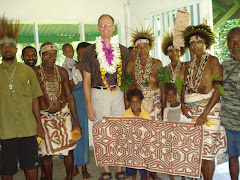
During my visit to Temotu Province last week, I was able to arrange for a visit an active volcano, Tinakula. A tall plume of steam and smoke streams from the top of a majestic cone rising direct from the sea. When I arrived at Lata Airport in Temotu last Saturday I noticed the volcano, and as Br. Jonas and I were crossing the beautiful bay I pointed it out and said I'd love to go. So for the price of a can of gasoline (Solomon Dollars $400.00--for six gallons. Divide by 13 to get USA equivalent.) First we visited a village on an island across from the volcano, populated by people who have fled the island. There we found two young men to guide us. Wednesday we set off. It was a two hour trip in driving rain. There are only two tiny beaches acccessible by canoe, the rest of the island is impregnable because of cliffs facing the sea. We took aim at the largest, about 100 yards of tumbling black stones. Our guide instructed us to make a tight circle with the canoe to position ourselves for a fully accelerated run at the beach between two huge submerged boulders. We waited for a big wave then with engine roaring at full speed we headed for the beach. He cut the motor when we seemed to hang over the beach, and we all jumped into the waves to catch the canoe and drag it above the water line. A most memorable landing. I was a bit shaky afterwards.
There is an old man, Hubert, who prefers to stay on the island. So his family comes out to visit him. Our guides were family and we were invited to stay for lunch. After an hour, a huge bowl of wild yams, steaming hot, was place on the floor of the hut. A Melanesian treat.
Lunch finished we threaded our way through heavy jungle to the beach and launched the canoe in reverse of our landing procedure: picking it up we dashed into the water, chasing a wave which carried us out beyond the submerged rocks, and we hauled ourselves panting into the canoe. We circled the island, which seemed lush and harmless until we rounded a point and saw the steep black face of stone. Boulders were detaching themselves and bounding down the cliff amid a shower of sparks. I quickly realized the stones were glowing red! No wonder the sensible portion of the population abandoned the island...
Most of my visit was less dangerous. I weeded the potatoe gardens at the friary, celebrated Eucharist, helped out in the kitchen. One night we stayed up late as I told stories in answer to their many questions about my travels. My stories began to sound like a luxury tour, though , when they shared about their recent travels. Four friars live at Holy Martyrs Friary. Their work is mostly pastoral, visiting both people locally on Santa Cruz Island, as well as going "on mission" to remoter places. The brothers undertook one such mission recently, leaving July 6 for a three week tour of some nearby islands. When the tour was complete, however, they had to wait a month for a boat to transport them back to Lata. When one finally arrived it was a cattle boat, and over 200 people camped on the exposed deck for a 10 day trip, suffering rain and sun and no privacy let alone seats or a bed! They arrived home September 17!! They were philosophical about the travel circumstances, rather recounted stories of people they met, the small kindnesses of passengers and crew, and how much they are looking forward to the next mission, and the chance to preach the Gospel.
Tuesday, September 22, 2009

Thursday, September 10, 2009
Sharing the life of the brothers
No electricity since July. Sorry for the huge gap in postings...Today's is long to catch you up!
I never made it in August to Jimi in Papua New Guinea to see the Br. Justus Friary the brothers are building there. Br. Reuben and I left Popondetta harbor near Katerada on the "Calvados Queen" August 7. When we arrived in Lae the next morning we were met by Brother Robert Eric. We immdeiately set out in a small bus for Mt. Hagen, going via Goroka. The drivers of these buses are fanatics. We careened around twisting mountain roads, tires screeching. The scenery was breath-taking, progressing from heavy tropical vegetation to cool upland pastures and huge cattle ranches in the Highlands. I felt like I might be in Montana or somewhere as I looked at the vast pastures ringed by beautiful mountains. We arrived in Goroka about 2:00 p.m., had lunch in a small chicken restaurant, then caught another bus for Mt. Hagen. Br. Robert arranged for the driver to leave us outside the gates of the rest house where we were going to stay because he said it was too dangerous to walk around after dark. There seems to be very little in the way of civil government or infrastructure in Mt. Hagen. Amazingly filthy and apparently teeming with thieves, it is also much colder than the coast, so I was freezing and glad to get into the guest house. There a bishop was also taking refuge, Bishop Nathan, regional bishop for the area that includes our friary in Jimi, his transport had ben cancelled due to bad weather. I'd met him at Lambeth, so we had a happy time catching up. The next morning Robert and I tried to go on to Jimi, but discovered after travelling for an hour, that there was no transportation for the last leg of the journey because the drivers were "Sunday Keepers." We hung around hoping for a Seventh Day Adventist driver, but nobody showed so we took a bus back to the rest house in Mt. Hagen. Bishop Nathan and Robert then began considering the possibility of reaching Jimi and getting back to Lae in time to catch the boat back to Popondetta. Not possible, they concluded. On their suggestion we investigated plane tickets but these proved too expensive and the next flights still meant several days wait. Finally I suggested we go back to Goroka, Robert's home town, and stay in the village of Siomoromoro. This proved to be a good idea.
We had a warm if somewhat surprised welcome, and were given places to stay in the men's guest house. I've visted Siomoromoro several times in the past so felt much at home. We spent Tuesday resting. The next day the local parish priest came for the celebration of St. Clare's Day; she is the patron saint of the village. It was a beautiful open air Mass. We sat on logs laid on the ground and a small altar was placed in front, covered by a cloth. Nearly every worshipper showed up with a bouquet of flowers, so the area was soon transformed by a riot of color, lit by brilliant sun and cooled by a breeze. Squatting there in the dust I reflected how pleased Clare would be. Here was perfect poverty. The priest preached about Clare defending Assisi from the Muslims by holding up the Blessed Sacrament, telling the people Holy Communion was the source of great strength and power in their lives. I found it very moving. After a bountiful parish lunch provided by the Mother's Union, Robert and I set off to visit Bishop Denis in Goroka. I left Robert in Goroka and teamed up with Reuben who had taken advantage of his free time to visit his family in the area. Then it was back on the wretched bus for Lae.
We arrived after dark and went looking for the Anglican rest house. No sooner had we started to walk though, when we were surrounded by people pulling at our baggage and yelling at us. I felt my stomach drop. Fortunately these were Good Samaritans warning us of the folly of walking after dark with back packs. However since I could not understand their language I was not sure what was happening as they bundled us onto an empty bus. I was very relieved to get to the rest house. Reuben and I were shoe horned into a cubicle ("How much are they charging us for this?" I asked Reuben in total dismay. "Franciscan brothers are free," he replied. It was a small but real consolation). The only open shop at that hour was the gas station Qwik Mart, so we ate a tin of corned beef on crackers for dinner.
Another overnight trip on a ship and I was back at Popondetta for a six hour lay over. (Shower and breakfast with the brothers at Katerada.) Then another two night journey to Alotau. The trips to Lae were fairly gruelling: over crowded, hot, ripe with odors. I was regretting my decision to go all the way to Alotau on the ship. But reminding myself that this is the way the ordinary friars travel, I scrambled for a seat on a bench, spreadng my luggage out so I might have space to sleep. It turned out to be a wonderful trip. Only 20 passengers, and the ship stopped often to drop off passengers or take on new ones, so we had a chance to get off the boat and buy food and drink. It was exquisite weather, and I soon made friends with several other passengers. It was August 15, the Feast of St. Mary the Virgin. I read my offices and found myself thinking about both the beauty and abundance of the earth and our voyage, plunging through the wind whipped, sun sparkled waters, and the poverty of the people and the copuntry. It seemed like an appropriate way to observe and remember Mary's life and obedience--poverty and beauty meeting together in the Incarnation. We sat together in the evenings on the wharf, eating whatever we had bought from the local women: fish, potatoes, sago pudding, cassava pudding, fresh bananas, coconuts, chestnuts (a tropical version thereof, heaven knows what they really are), and best of all, coffee. Arriving in Alotau at 8:00 a.m. we waited for three hours while a private yacht re-fueled. The yacht ignored our captain's repeated appeals to them to allow us to disembark, so we circled, peering in at the priviledged life of white North Americans: chef, waiters, ski jets, speed boats, young women in bikinis, and they peered down at us, a filthy ship, passengers raggedy, worn from three days travel, surrounded by frayed homemade luggage of palm leaf, betel nut stained mouths. I was so happy to be on the latter ship. Finally we were instructed to scramble off the ship onto a barge which was docked at the wharf, and cross over to land.
Br. Ham met me and we then got onto a flat bed truck that dropped us off at the end of the road leading to the friary. It was a joy to get there! First order of business was a bath in the river and then food. That evening we said good-bye and prayed our farewells with a young brother. I'd received his vows on Palm Sunday 2008, so it was with a real sense of ambivalence that I received his habit back. but he'd managed to become a father in the interim, so we had no choice. It was tearful.
The rest of my time was caught up with pastoral work with the brothers, meeting neighbors.
August 20 I flew (time was a-wastin') to Port Moresby and on the 21 of August I flew to the Solomon Islands.
Arrival in the Solomons is always a fairly easy ritual. They recognize my brown shirt and cross and wave me through saying "Welcome Brother!" After an overnight stay in Honiara, a whole truck load of brothers went to Hautambu for the first official Provincial Chapter since the creation of the Province of the Solomon Islands at our First Order Chapter last September. It was a good chapter and they enacted several changes, saying "Now we are a Province we must..." Most notable among these changes the Chapter adopted a zero tolerance no-alcohol policy. One drink and you are out. Alcohol abuse has wreaked real havoc on the friary buildings, spoiled the vocations of some wonderful men, compromised the reputation of the Franciscans within the Church of Melanesia. Brothers have stolen from the friary budgets to buy drink, diverted funds from their appeals. Completely fed up, I said "We need a policy that can be enforced! Enough preaching and moral exhorations!" I was surprised by how quickly they responded. A committee met and the next day the new policy was adopted. Most brothers expressed relief and gratitude. Some weren't quite so pleased but recognized the need for it. So far nobody has had to leave! When I visited the Archbishop later the next week he was delighted and hopes a similar policy will be adopted by the Melanesian Brotherhood.
After Chapter finished I offered my services to teach the novices and postulants, and so have spent a very happy 10 days doing that. I've been indulging my love of storytelling, recounting tales about St. Francis and then making connections between the stories and the brother's lives, helping them identify Franciscan values and giving an introduction to Franciscan spirituality. I took advantage of the free time to get back in shape, running every other day, and am now back to my usual form.
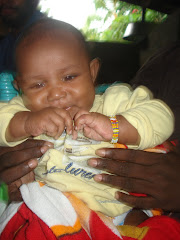
The most amazing and wonderful event during my stay in the Solomons so far has been the baptism of Clark Elcuwyn Kae Kae! His parents asked to name him after me since they asked me to pray that they would have a child during my last visit to the Solomons. His father Selwyn was a brother during my first visit to the Solomons in 1995-96, the mother Ellen Fox was a sister of the Sisters of Melanesia. He joins a sister Cuthberta (named by my predecessor as Minister General, Br. Daniel).
Tomorrow I go the most remote friary of the Province, in a place called Temotu. It is several hours by air, and then involves a canoe ride across a lagoon.
On the ride into town today I was thinking that today is September 11, and remembering the events of 2001. Thank God there have been no more attacks, I pray for a speedy end to the war in Iraq and Afghanistan and deepening relationships of trust and understanding with Muslims.
I never made it in August to Jimi in Papua New Guinea to see the Br. Justus Friary the brothers are building there. Br. Reuben and I left Popondetta harbor near Katerada on the "Calvados Queen" August 7. When we arrived in Lae the next morning we were met by Brother Robert Eric. We immdeiately set out in a small bus for Mt. Hagen, going via Goroka. The drivers of these buses are fanatics. We careened around twisting mountain roads, tires screeching. The scenery was breath-taking, progressing from heavy tropical vegetation to cool upland pastures and huge cattle ranches in the Highlands. I felt like I might be in Montana or somewhere as I looked at the vast pastures ringed by beautiful mountains. We arrived in Goroka about 2:00 p.m., had lunch in a small chicken restaurant, then caught another bus for Mt. Hagen. Br. Robert arranged for the driver to leave us outside the gates of the rest house where we were going to stay because he said it was too dangerous to walk around after dark. There seems to be very little in the way of civil government or infrastructure in Mt. Hagen. Amazingly filthy and apparently teeming with thieves, it is also much colder than the coast, so I was freezing and glad to get into the guest house. There a bishop was also taking refuge, Bishop Nathan, regional bishop for the area that includes our friary in Jimi, his transport had ben cancelled due to bad weather. I'd met him at Lambeth, so we had a happy time catching up. The next morning Robert and I tried to go on to Jimi, but discovered after travelling for an hour, that there was no transportation for the last leg of the journey because the drivers were "Sunday Keepers." We hung around hoping for a Seventh Day Adventist driver, but nobody showed so we took a bus back to the rest house in Mt. Hagen. Bishop Nathan and Robert then began considering the possibility of reaching Jimi and getting back to Lae in time to catch the boat back to Popondetta. Not possible, they concluded. On their suggestion we investigated plane tickets but these proved too expensive and the next flights still meant several days wait. Finally I suggested we go back to Goroka, Robert's home town, and stay in the village of Siomoromoro. This proved to be a good idea.
We had a warm if somewhat surprised welcome, and were given places to stay in the men's guest house. I've visted Siomoromoro several times in the past so felt much at home. We spent Tuesday resting. The next day the local parish priest came for the celebration of St. Clare's Day; she is the patron saint of the village. It was a beautiful open air Mass. We sat on logs laid on the ground and a small altar was placed in front, covered by a cloth. Nearly every worshipper showed up with a bouquet of flowers, so the area was soon transformed by a riot of color, lit by brilliant sun and cooled by a breeze. Squatting there in the dust I reflected how pleased Clare would be. Here was perfect poverty. The priest preached about Clare defending Assisi from the Muslims by holding up the Blessed Sacrament, telling the people Holy Communion was the source of great strength and power in their lives. I found it very moving. After a bountiful parish lunch provided by the Mother's Union, Robert and I set off to visit Bishop Denis in Goroka. I left Robert in Goroka and teamed up with Reuben who had taken advantage of his free time to visit his family in the area. Then it was back on the wretched bus for Lae.
We arrived after dark and went looking for the Anglican rest house. No sooner had we started to walk though, when we were surrounded by people pulling at our baggage and yelling at us. I felt my stomach drop. Fortunately these were Good Samaritans warning us of the folly of walking after dark with back packs. However since I could not understand their language I was not sure what was happening as they bundled us onto an empty bus. I was very relieved to get to the rest house. Reuben and I were shoe horned into a cubicle ("How much are they charging us for this?" I asked Reuben in total dismay. "Franciscan brothers are free," he replied. It was a small but real consolation). The only open shop at that hour was the gas station Qwik Mart, so we ate a tin of corned beef on crackers for dinner.
Another overnight trip on a ship and I was back at Popondetta for a six hour lay over. (Shower and breakfast with the brothers at Katerada.) Then another two night journey to Alotau. The trips to Lae were fairly gruelling: over crowded, hot, ripe with odors. I was regretting my decision to go all the way to Alotau on the ship. But reminding myself that this is the way the ordinary friars travel, I scrambled for a seat on a bench, spreadng my luggage out so I might have space to sleep. It turned out to be a wonderful trip. Only 20 passengers, and the ship stopped often to drop off passengers or take on new ones, so we had a chance to get off the boat and buy food and drink. It was exquisite weather, and I soon made friends with several other passengers. It was August 15, the Feast of St. Mary the Virgin. I read my offices and found myself thinking about both the beauty and abundance of the earth and our voyage, plunging through the wind whipped, sun sparkled waters, and the poverty of the people and the copuntry. It seemed like an appropriate way to observe and remember Mary's life and obedience--poverty and beauty meeting together in the Incarnation. We sat together in the evenings on the wharf, eating whatever we had bought from the local women: fish, potatoes, sago pudding, cassava pudding, fresh bananas, coconuts, chestnuts (a tropical version thereof, heaven knows what they really are), and best of all, coffee. Arriving in Alotau at 8:00 a.m. we waited for three hours while a private yacht re-fueled. The yacht ignored our captain's repeated appeals to them to allow us to disembark, so we circled, peering in at the priviledged life of white North Americans: chef, waiters, ski jets, speed boats, young women in bikinis, and they peered down at us, a filthy ship, passengers raggedy, worn from three days travel, surrounded by frayed homemade luggage of palm leaf, betel nut stained mouths. I was so happy to be on the latter ship. Finally we were instructed to scramble off the ship onto a barge which was docked at the wharf, and cross over to land.
Br. Ham met me and we then got onto a flat bed truck that dropped us off at the end of the road leading to the friary. It was a joy to get there! First order of business was a bath in the river and then food. That evening we said good-bye and prayed our farewells with a young brother. I'd received his vows on Palm Sunday 2008, so it was with a real sense of ambivalence that I received his habit back. but he'd managed to become a father in the interim, so we had no choice. It was tearful.
The rest of my time was caught up with pastoral work with the brothers, meeting neighbors.
August 20 I flew (time was a-wastin') to Port Moresby and on the 21 of August I flew to the Solomon Islands.
Arrival in the Solomons is always a fairly easy ritual. They recognize my brown shirt and cross and wave me through saying "Welcome Brother!" After an overnight stay in Honiara, a whole truck load of brothers went to Hautambu for the first official Provincial Chapter since the creation of the Province of the Solomon Islands at our First Order Chapter last September. It was a good chapter and they enacted several changes, saying "Now we are a Province we must..." Most notable among these changes the Chapter adopted a zero tolerance no-alcohol policy. One drink and you are out. Alcohol abuse has wreaked real havoc on the friary buildings, spoiled the vocations of some wonderful men, compromised the reputation of the Franciscans within the Church of Melanesia. Brothers have stolen from the friary budgets to buy drink, diverted funds from their appeals. Completely fed up, I said "We need a policy that can be enforced! Enough preaching and moral exhorations!" I was surprised by how quickly they responded. A committee met and the next day the new policy was adopted. Most brothers expressed relief and gratitude. Some weren't quite so pleased but recognized the need for it. So far nobody has had to leave! When I visited the Archbishop later the next week he was delighted and hopes a similar policy will be adopted by the Melanesian Brotherhood.
After Chapter finished I offered my services to teach the novices and postulants, and so have spent a very happy 10 days doing that. I've been indulging my love of storytelling, recounting tales about St. Francis and then making connections between the stories and the brother's lives, helping them identify Franciscan values and giving an introduction to Franciscan spirituality. I took advantage of the free time to get back in shape, running every other day, and am now back to my usual form.
The most amazing and wonderful event during my stay in the Solomons so far has been the baptism of Clark Elcuwyn Kae Kae! His parents asked to name him after me since they asked me to pray that they would have a child during my last visit to the Solomons. His father Selwyn was a brother during my first visit to the Solomons in 1995-96, the mother Ellen Fox was a sister of the Sisters of Melanesia. He joins a sister Cuthberta (named by my predecessor as Minister General, Br. Daniel).
Tomorrow I go the most remote friary of the Province, in a place called Temotu. It is several hours by air, and then involves a canoe ride across a lagoon.
On the ride into town today I was thinking that today is September 11, and remembering the events of 2001. Thank God there have been no more attacks, I pray for a speedy end to the war in Iraq and Afghanistan and deepening relationships of trust and understanding with Muslims.
Monday, August 3, 2009
Going to Jimi
Once the celebrations were over, the brothers had to quickly shift gears and prepare for Chapter. Fortunately Monday was a free day. Everybody slept. Some friends stayed on to help clean up and prepare a special lunch for us. I got in a satisfying six mile run into the Cathedral and back. Then, late in the afternoon we moved ourselves to Hetune Convent with the Commuity of the Visitation of Our Lady (the CVL Sisters). They'd bravely welcomed us even though their generator wasn't working so there was no electricity, and no running water. We couldn't have cared less!
Tuesday was a Quiet Day with addresses given by the retired Bishop of Dogura, Bishop Sanana. He talked about the adventure of our calling. I was all ears. Much of what he said rang true to me and echoed many of the things we'd heard in America during the Formator's conference. A very pleasant surprise.
Then there was Chapter: reports, discussions, votes. We elected Brother Charles Iada to Life Profession, Br. Samuel Pokia to First Profession. We welcomed back into the noviciate a man (Jerry Ross) who been a brother before (and shared the same date of Profession with me--I was professed in New York October 16, 1993 and he'd been professed that day in PNG). There were a few farewells: the Guardianship of Haruro changed because Wallace's term was up. We elected Selwyn Suma the new Guardian. Br. Gabriel was released from Vows.
As familiar as the process was to all of us, it had a sense of being extra important: the first provincial chapter of the new Province of Papua New Guinea.
We were bone tired by the time we got back to the Friary Friday, but there were still loose ends to tie up. So Saturday was spent waiting. Unfortuantely it took until Saturday night to get everybody together to dot the "i's" and cross the "t's".
Sunday I celebrated and preached: oofdah! But then it was bathing in the river, sleeping in a cool breeze, reading a novel.
Thursday of this week I head off on an adventure: going by ship overnight up the coast to Lae. Br. Robert Eric will meet me and we will leap onto one of the huge trucks cum rural bus called PMV's and travel most of a day to the point closest to the trail head which we will then hike to a village called Jimi and visit the place Br. Justus Van Houten died in 2006. The Brothers have built a friary there, named after Br. Justus. I am also going to meet with the people and assure them of SSF's love and gratitude to them for all that they did for Justus.
Tuesday was a Quiet Day with addresses given by the retired Bishop of Dogura, Bishop Sanana. He talked about the adventure of our calling. I was all ears. Much of what he said rang true to me and echoed many of the things we'd heard in America during the Formator's conference. A very pleasant surprise.
Then there was Chapter: reports, discussions, votes. We elected Brother Charles Iada to Life Profession, Br. Samuel Pokia to First Profession. We welcomed back into the noviciate a man (Jerry Ross) who been a brother before (and shared the same date of Profession with me--I was professed in New York October 16, 1993 and he'd been professed that day in PNG). There were a few farewells: the Guardianship of Haruro changed because Wallace's term was up. We elected Selwyn Suma the new Guardian. Br. Gabriel was released from Vows.
As familiar as the process was to all of us, it had a sense of being extra important: the first provincial chapter of the new Province of Papua New Guinea.
We were bone tired by the time we got back to the Friary Friday, but there were still loose ends to tie up. So Saturday was spent waiting. Unfortuantely it took until Saturday night to get everybody together to dot the "i's" and cross the "t's".
Sunday I celebrated and preached: oofdah! But then it was bathing in the river, sleeping in a cool breeze, reading a novel.
Thursday of this week I head off on an adventure: going by ship overnight up the coast to Lae. Br. Robert Eric will meet me and we will leap onto one of the huge trucks cum rural bus called PMV's and travel most of a day to the point closest to the trail head which we will then hike to a village called Jimi and visit the place Br. Justus Van Houten died in 2006. The Brothers have built a friary there, named after Br. Justus. I am also going to meet with the people and assure them of SSF's love and gratitude to them for all that they did for Justus.
50 Years in the Pacific
After my arrival in Papua New Guinea, I was housed, with Brothers Brian, Alfred, and Giles at a guest house in Port Moresby. The chief distinguishing characteristic of this guest house was the size of the cockroaches: the largest I've ever seen in my life! But they were a source of amusement when the conversation flagged to track them down. In many ways this gathering was like any family reunion: out of town guests sitting around motel rooms. Special meals and outings. Some of us had never met, some were very familiar. Finally it was time to go to the airport to fly to Popondetta for the manin event. After only a half hour flight we arrived and I could see out the window a small bevy of girls in traditional costume. Each of us was greeted with a flower lei. A new bench mark for airport arrivals! Then we got into a hired van and were driven to the friary.
Br. Brian was asked to knock at a temporary barricade set up across the road, and then a voice called out a challenge. I was nudged from behind and told to say "We are Franciscans!" We did this three times and then the barricade came down to reveal maybe 50 people in feathers and tapa cloth, with drums, spears and flowers, shouting "Oro! Oro! Oro!" (Welcome! Welcome! Welcome!). Led by a man I concluded must be the chief, they sang and danced all of the way to the friary central lawn. There we had speeches, more singing and handshaking, nearly every brother in the province was there to greet us. It was particularly moving to see some of the older people in the crowd fall on
Br. Brian with shouts of joy and tears. One of the men I noticed I later met as the man who built the friary 50 years ago.
The next day, Saturday, we spent being entertained in grand Papua New Guinean style. Meanwhile there was incredibly intense activity going on behind the friary and in the surrounding area. I could hear axes chopping wood, women singing, smoke spiralling into the air. At one point a pig, trussed and suspended on a pole was carried through the central lawn, accompanied by the same band of singers and dancers, singing much the same sorts of songs as when they greeted us. It was a way of rejoicing and giving thanks for the pig and its life. Poor pig. But the food was fabulous. The brothers organized a vocational school with catering classes to prepare the food for the weekend. It was all local food, but beautifully presented: bananas of many kinds and divers preparations, yams, taro, aibica, papaya, chicken, rice, cassava, kau-kau. Heavy on the starches, but absolutely delicious and just the right thing to serve on this occasion. SSF has become entirely Papua New Guinean.
Br. Oswald officiated at a beautiful Solemn Evensong Saturday evening. We'd intended to bless a plaque presented by the European Province brothers commemorating the first 4 SSF brothers to go to Papua New Ginea in 1959 (Geoffrey, Mark, Steven and Andrew). But during Evensong we could hear hammering and the sounds of cement being mixed in a barrel nearby. Obviously no plaque would be placed there that night. But by morning, the forms were gone, there was a beautiful pedestal and the plaque was there, covered by a piece of brown cloth.
The solemn procession began at the friary gate, with the Bishop Protector Joseph Kopapa (a novice in the Third Order SSF) shovelling incense on the thurible. The smell of incense mingled with the smell of roasting pork and vegetables from the four stone muu-muus (traditional stone ovens) ranged behind the friary. Several hundred people had stayed up all night long to prepare three pigs, tons of sweet potatoes and yams and other delicacies. Then they donned their costumes and escorted us into church through a large crowd of other people, pressing in and waving. The brothers had designed a terrific liturgy, with every local institution sending a group of dancers. We danced the Gloria, the Gospel procession, the Offertory, the Great Amen, and then danced our way out to bless the plaque in the memorial garden/graveyard behind the Chapel. Br. Brian's sermon recapped the adventure of the early days and the incredible generosity of the people who originally welcomed the Brothers. But he spoke to larger themes, illustrating Franciscan spirituality with all that he said. It was masterfully done.
Then came the feasting. More dancing. And then presentations to the brothers. Some were invited to give speeches, but there seemed to be several spontaneous ones. As always children featured prominently in the festivities, and provided some moments of hilarity as they toddled among their parents, all decked out as tiny warriors. I was particularly struck by the number of teenagers among the performers. I asked one parent who came to rest near me: "Do you have trouble convincing the teenagers to dress up in traditional costume and dance like that?" I was assured they loved it and were proud of their culture. The whole weekend was animated by a passionate sense of a living cultural tradition which has embraced the Gospel message and Franciscan way of life. I was particularly moved to see the brothers in their full Franciscan habits overlayed by feather and shell ornaments, their faces marked with painted designs.
I had wondered how we might assess the impact of 50 years of the Order in PNG. But there was no mystery to it. The presence of many bishops, hundreds of people, representatives of the government, children, cats, dogs and domesticated jungle creatures that one woman permitted to crawl all over her I knew that the Society of St. Francis had made a difference, and been changed forever in the bargain.
Thanks be to God.
Br. Brian was asked to knock at a temporary barricade set up across the road, and then a voice called out a challenge. I was nudged from behind and told to say "We are Franciscans!" We did this three times and then the barricade came down to reveal maybe 50 people in feathers and tapa cloth, with drums, spears and flowers, shouting "Oro! Oro! Oro!" (Welcome! Welcome! Welcome!). Led by a man I concluded must be the chief, they sang and danced all of the way to the friary central lawn. There we had speeches, more singing and handshaking, nearly every brother in the province was there to greet us. It was particularly moving to see some of the older people in the crowd fall on
Br. Brian with shouts of joy and tears. One of the men I noticed I later met as the man who built the friary 50 years ago.
The next day, Saturday, we spent being entertained in grand Papua New Guinean style. Meanwhile there was incredibly intense activity going on behind the friary and in the surrounding area. I could hear axes chopping wood, women singing, smoke spiralling into the air. At one point a pig, trussed and suspended on a pole was carried through the central lawn, accompanied by the same band of singers and dancers, singing much the same sorts of songs as when they greeted us. It was a way of rejoicing and giving thanks for the pig and its life. Poor pig. But the food was fabulous. The brothers organized a vocational school with catering classes to prepare the food for the weekend. It was all local food, but beautifully presented: bananas of many kinds and divers preparations, yams, taro, aibica, papaya, chicken, rice, cassava, kau-kau. Heavy on the starches, but absolutely delicious and just the right thing to serve on this occasion. SSF has become entirely Papua New Guinean.
Br. Oswald officiated at a beautiful Solemn Evensong Saturday evening. We'd intended to bless a plaque presented by the European Province brothers commemorating the first 4 SSF brothers to go to Papua New Ginea in 1959 (Geoffrey, Mark, Steven and Andrew). But during Evensong we could hear hammering and the sounds of cement being mixed in a barrel nearby. Obviously no plaque would be placed there that night. But by morning, the forms were gone, there was a beautiful pedestal and the plaque was there, covered by a piece of brown cloth.
The solemn procession began at the friary gate, with the Bishop Protector Joseph Kopapa (a novice in the Third Order SSF) shovelling incense on the thurible. The smell of incense mingled with the smell of roasting pork and vegetables from the four stone muu-muus (traditional stone ovens) ranged behind the friary. Several hundred people had stayed up all night long to prepare three pigs, tons of sweet potatoes and yams and other delicacies. Then they donned their costumes and escorted us into church through a large crowd of other people, pressing in and waving. The brothers had designed a terrific liturgy, with every local institution sending a group of dancers. We danced the Gloria, the Gospel procession, the Offertory, the Great Amen, and then danced our way out to bless the plaque in the memorial garden/graveyard behind the Chapel. Br. Brian's sermon recapped the adventure of the early days and the incredible generosity of the people who originally welcomed the Brothers. But he spoke to larger themes, illustrating Franciscan spirituality with all that he said. It was masterfully done.
Then came the feasting. More dancing. And then presentations to the brothers. Some were invited to give speeches, but there seemed to be several spontaneous ones. As always children featured prominently in the festivities, and provided some moments of hilarity as they toddled among their parents, all decked out as tiny warriors. I was particularly struck by the number of teenagers among the performers. I asked one parent who came to rest near me: "Do you have trouble convincing the teenagers to dress up in traditional costume and dance like that?" I was assured they loved it and were proud of their culture. The whole weekend was animated by a passionate sense of a living cultural tradition which has embraced the Gospel message and Franciscan way of life. I was particularly moved to see the brothers in their full Franciscan habits overlayed by feather and shell ornaments, their faces marked with painted designs.
I had wondered how we might assess the impact of 50 years of the Order in PNG. But there was no mystery to it. The presence of many bishops, hundreds of people, representatives of the government, children, cats, dogs and domesticated jungle creatures that one woman permitted to crawl all over her I knew that the Society of St. Francis had made a difference, and been changed forever in the bargain.
Thanks be to God.
Wednesday, July 22, 2009
PNG at Last
After the "perfect storm" of exigencies and snafus I got may passport from a Fedex facilitiy in Ronkonkoma NY at 8:30 a.m. Monday morning. It was then pell mell back to Little Portion and I caught the 10:10 train to New York City. The call of the open skies. Nearly 23 hours of flying time plus a six hour lay over in Hong Kong later. I arribved in Port Moresby, Papua New GuineaNever have I been so glad to get somewhere. I even enjoyed the two hour delay in the Immigration line at the airport as they sifted through every article in the luggage of a plane load of Chinese business men who flew from Hong Kong with me.
The water at the St. Francis School has been turned off since the school admoinistration didn't pay the bill. So the brothers are without water too. With 6 guests from overseas they have bunked us in very pleasant quarters not far away--but with lots of water. Today we are being given the "grand tour" or Port Moresby, then tomorrow we fly over to Popondetta for the Big Weekend. The Society of St. Francis is celebrating the 50th Anniversary of the arrival of the first SSF brothers in the Pacific Region. From those early days the Holy Spirit has called many men to test their vocations, and today there are three separate provinces in the Pacific, with over a 100 brothers among them. We have much to celebrate.
The water at the St. Francis School has been turned off since the school admoinistration didn't pay the bill. So the brothers are without water too. With 6 guests from overseas they have bunked us in very pleasant quarters not far away--but with lots of water. Today we are being given the "grand tour" or Port Moresby, then tomorrow we fly over to Popondetta for the Big Weekend. The Society of St. Francis is celebrating the 50th Anniversary of the arrival of the first SSF brothers in the Pacific Region. From those early days the Holy Spirit has called many men to test their vocations, and today there are three separate provinces in the Pacific, with over a 100 brothers among them. We have much to celebrate.
Formator's Conference
From the moment I arrived in the United States June 24 until I left again July 20 my time was consumed with the Formator's Conference. I worked on the plans for this conference for many months, pecking away in internet cafes and using my cell phone to make arrangements with different participants. It was an amazing experience. At the end of the three week program Sr. Joyce and I wrote an introduction to the new internaional curriculum, which I have excerpted here:
"It gives us great pleasure in introducing this curriculum to you. It is the result of the input, experience and hard work together of participants in this Formators’ Conference. Those who participated came to Little Portion, Long Island, from all Provinces of SSF and from CDC, Zimbabwe. This was an historic occasion!
The participants were: Clifton Henry and Samson Siho (Province of the Solomon Islands); Lester Meso and Philip Etobae (Papua New Guinea Province); Bhekimpilo (CDC, Zimbabwe); Donald Campbell, who could only attend for half the conference, and Nathan James (Australia/New Zealand Province); Pamela Clare and Eric Michael (Province of the Americas); Jenny Tee, Desmond Alban and John (European Province), together with us Ministers General.
The impetus for this meeting came out of the last Chapter of the First Order, September 2008, where there was much concern expressed about Formation, especially up to Life Profession. The goal was to produce a ‘road map’, something that would be flexible enough to cross the boundaries of our different cultures and contexts in order to build up confidence especially for those given the direct responsibility for Formation. As Don Bisson said, “if you are in Formation, you are in formation”. However, we also recognized that the formation of our newest members lies with all of us. Each new member who joins us is expected to change in the process of development, but unless the Community changes too there is the likelihood of slow strangulation or torture of the new member.
So we undertook some formative experiences around some core Franciscan values to hear some ‘parables of formation’, to open our understanding to what might be possible and how to do formation by listening to those who work for environmental justice, social justice, and ecumenical and inter-faith relations. First we met with Don Bisson, Marist Brother, about how to do Formation. Travelling by van, and some sleeping on church hall floors, we met in New York City with the West Harlem Environmental Initiative, the Poverty Initiative at Union Seminary and the parish of St. Mary’s in Harlem. We then went to Graymoor as the guests of the Brothers of the Society of the Atonement to discuss ecumenical relations. We visited the Chaung Yen Buddhist Monastery to experience inter-faith relations. We also had the opportunity to meet with the Sisters of the Atonement and the Franciscan Missionary Sisters at Peekskill (where the founder of CSF died as a member of that Roman Catholic congregation). We travelled on to Boston and the Society of St. John the Evangelist, Ecclesia Ministries, and a meeting with Dr. Kwok Pui-Lan at Episcopal Divinity School.
On returning to Little Portion, we received advice on curriculum development from Wendell Chu, Superintendent of Islip School District on Long Island, Lucas Benitez, founder of the Coalition of Immokalee Workers and Derrick McQueen of the Poverty Initiative who gave us very valuable help in facing some of the challenges in developing this curriculum..."
So it is finished; let the good times roll!
"It gives us great pleasure in introducing this curriculum to you. It is the result of the input, experience and hard work together of participants in this Formators’ Conference. Those who participated came to Little Portion, Long Island, from all Provinces of SSF and from CDC, Zimbabwe. This was an historic occasion!
The participants were: Clifton Henry and Samson Siho (Province of the Solomon Islands); Lester Meso and Philip Etobae (Papua New Guinea Province); Bhekimpilo (CDC, Zimbabwe); Donald Campbell, who could only attend for half the conference, and Nathan James (Australia/New Zealand Province); Pamela Clare and Eric Michael (Province of the Americas); Jenny Tee, Desmond Alban and John (European Province), together with us Ministers General.
The impetus for this meeting came out of the last Chapter of the First Order, September 2008, where there was much concern expressed about Formation, especially up to Life Profession. The goal was to produce a ‘road map’, something that would be flexible enough to cross the boundaries of our different cultures and contexts in order to build up confidence especially for those given the direct responsibility for Formation. As Don Bisson said, “if you are in Formation, you are in formation”. However, we also recognized that the formation of our newest members lies with all of us. Each new member who joins us is expected to change in the process of development, but unless the Community changes too there is the likelihood of slow strangulation or torture of the new member.
So we undertook some formative experiences around some core Franciscan values to hear some ‘parables of formation’, to open our understanding to what might be possible and how to do formation by listening to those who work for environmental justice, social justice, and ecumenical and inter-faith relations. First we met with Don Bisson, Marist Brother, about how to do Formation. Travelling by van, and some sleeping on church hall floors, we met in New York City with the West Harlem Environmental Initiative, the Poverty Initiative at Union Seminary and the parish of St. Mary’s in Harlem. We then went to Graymoor as the guests of the Brothers of the Society of the Atonement to discuss ecumenical relations. We visited the Chaung Yen Buddhist Monastery to experience inter-faith relations. We also had the opportunity to meet with the Sisters of the Atonement and the Franciscan Missionary Sisters at Peekskill (where the founder of CSF died as a member of that Roman Catholic congregation). We travelled on to Boston and the Society of St. John the Evangelist, Ecclesia Ministries, and a meeting with Dr. Kwok Pui-Lan at Episcopal Divinity School.
On returning to Little Portion, we received advice on curriculum development from Wendell Chu, Superintendent of Islip School District on Long Island, Lucas Benitez, founder of the Coalition of Immokalee Workers and Derrick McQueen of the Poverty Initiative who gave us very valuable help in facing some of the challenges in developing this curriculum..."
So it is finished; let the good times roll!
Tuesday, June 16, 2009
O to be a bird!
Because I studied theatre (among other things) in England when I was in college, I always associate England with theatre. But I was in a student's paradise all those years ago, and have never been able to afford to see many plays on return visits to the UK. But while I was in Canterbury last week the brothers got a chance to go to a performance of Dario Fo's "Francis, the Holy Jester." We trooped off to Margate (a small town about 15 miles outside Canterbury, on the sea coast) to the ancient (okay, Eighteenth Century--I am an American after all) Theatre Royal. I was happy to be going to a play, and knew nothing of who Dario Fo was nor much about the play except it was about Francis. I really had a treat! The actor, Mario Pirovano was electric, and supplemented a manic text with pointed asides (i.e. "It is all allegory: the wolf of Gubbio was a rapacious politician!"). Fo aimed to liberate Francis from the birdbath and unleash some of the Good News in contemporary hearts. Here is a passage from the play:
"It is almost sunset and Francis's companions, exhausted as they are, drop to the ground and fall fast asleep. Francis stands under a huge tree--it's enormous, with a lot of branches, full of leavews, and little birds hopping and chirping, flying around looking for a good place to spend the night. Francis looks at them: 'oh, birds, how blissful you are, what a marvel! So light you are, and overflowing with joy, you don't have a care and you fly, flapping y0ur wings in the wind, in the air, so easily and in harmony. In the air which is so close to God that surely it is His very breath...perhaps the breeze itself is God...and the wind...and God raises you with His hands and makes you fly!' While Francis is speaking the words of this prayer, many other birds arrive from all around, birds of all kinds: finches, crows and hawks, even buzzards and eagles from the mountains and birds from the sea and the rivers. The tree fills up with birds--so many that you can't see a single leaf--and they all listen: 'Oh blissful birds, who are free and light, who live without possessions, with no burdens to weigh you down and no power to enslave you! Oh if men too could be so light, without any loads crushing us--men who brag, full of greed, and thirst for possessions, and desire for glory; crazed to the point of overpowering each other, clambering on other people's heads in order to appear bigger and taller than everybody else--lies! Rogueries! Wickedness and lack of love! Oh, if we could free ourselves from this burden, be stripped of this wretched passion, we could be so light as to levitate up into the sky, and the puff of a child would be enough to make us fly!' While still speaking, Francis turns slightly and notices that, on the wide road behind him, a crowd of people are listening to him. There are women crying, men holding their breath, unable to applaud. And Francis looks up at the sky and says: 'How strange this world is! To make people listen to you, you must speak to the birds!'
Francis the Holy Jester has inspired and agitated many people over the years. Here Matthew and Vaughan become novices at Hilfield May 30. During my time at Hilfield I spent some time reading Br. Bernard's autobiography "My God, My All: A friar's journey". I dog eared several pages of the book, impressed how he sometimes sounded a bit like me. Or perhaps how there is something universal in our vocation? At any rate, he wrote about his desire to be a
brother which reminded me of why I wanted to be a brother and perhaps why I loved Fo's play so much: "One afternoon in my third year at Cambridge, standing in the sitting rom of my digs, I quite suddenly felt in my deepest self that God was asking me to become a friar. I had very mixed feelings. Perhaps the first was horror: 'Oh no Lord!' I then moved onto self exploration...I was attracted by the itinerant mission of the brothers, the desire to serve the most needy, and the life of communal prayer and meditation'(page 108). I think my call was something like that. It has been an unfolding adventure, and even required me to do things I'd rather not, like deal with money and help make decisions about things like that, and help extend and maintain buildings which we use to roost in between our travels. At the Central Fund meeting in London after my time in Canterbury, the Solomon Islands province requestd some money to extend their chapel since the current one only seats 80, and so many come to listen to the brothers and share in their worship (inspired by birdsong a brother once told me). But it was a lovely soaring feeling to present their case to the trustees and get the funding. (I just learned today they are taking the Franciscan message to a new place, Vanuatu.)This is a picture of Brother Gerardo, one of our itinerant novices (from Mexico)
A new stop on my UK travels this visit has been the Poor Clares convent in Freeland, outside Oxford. I wonder if Fo knows them? They seem very free, ordering their life to protect their passion for prayer (and jam making, chicken farming, card making) and carrying out radical hospitality. I was surprised by the diversity of folks I met in the space of a few short days, and heard some of the stories of the sisters' ministry. Itinerancy is not always just about moving around physically; it includes a wide open attitude. Spiritual freedom recognizes no barriers, I think.
From Oxford I flew north on the Cross Country railroad to Alnmouth. Here too, the community practices radical hospitality. And I can run along the bluffs, and dip down and skim the tidal flats (some might say lumber like a water buffalo, but it is what I feel inside that counts).

All the brothers at the annual brothers meeting at Hilfield June 2
"It is almost sunset and Francis's companions, exhausted as they are, drop to the ground and fall fast asleep. Francis stands under a huge tree--it's enormous, with a lot of branches, full of leavews, and little birds hopping and chirping, flying around looking for a good place to spend the night. Francis looks at them: 'oh, birds, how blissful you are, what a marvel! So light you are, and overflowing with joy, you don't have a care and you fly, flapping y0ur wings in the wind, in the air, so easily and in harmony. In the air which is so close to God that surely it is His very breath...perhaps the breeze itself is God...and the wind...and God raises you with His hands and makes you fly!' While Francis is speaking the words of this prayer, many other birds arrive from all around, birds of all kinds: finches, crows and hawks, even buzzards and eagles from the mountains and birds from the sea and the rivers. The tree fills up with birds--so many that you can't see a single leaf--and they all listen: 'Oh blissful birds, who are free and light, who live without possessions, with no burdens to weigh you down and no power to enslave you! Oh if men too could be so light, without any loads crushing us--men who brag, full of greed, and thirst for possessions, and desire for glory; crazed to the point of overpowering each other, clambering on other people's heads in order to appear bigger and taller than everybody else--lies! Rogueries! Wickedness and lack of love! Oh, if we could free ourselves from this burden, be stripped of this wretched passion, we could be so light as to levitate up into the sky, and the puff of a child would be enough to make us fly!' While still speaking, Francis turns slightly and notices that, on the wide road behind him, a crowd of people are listening to him. There are women crying, men holding their breath, unable to applaud. And Francis looks up at the sky and says: 'How strange this world is! To make people listen to you, you must speak to the birds!'
Francis the Holy Jester has inspired and agitated many people over the years. Here Matthew and Vaughan become novices at Hilfield May 30. During my time at Hilfield I spent some time reading Br. Bernard's autobiography "My God, My All: A friar's journey". I dog eared several pages of the book, impressed how he sometimes sounded a bit like me. Or perhaps how there is something universal in our vocation? At any rate, he wrote about his desire to be a

brother which reminded me of why I wanted to be a brother and perhaps why I loved Fo's play so much: "One afternoon in my third year at Cambridge, standing in the sitting rom of my digs, I quite suddenly felt in my deepest self that God was asking me to become a friar. I had very mixed feelings. Perhaps the first was horror: 'Oh no Lord!' I then moved onto self exploration...I was attracted by the itinerant mission of the brothers, the desire to serve the most needy, and the life of communal prayer and meditation'(page 108). I think my call was something like that. It has been an unfolding adventure, and even required me to do things I'd rather not, like deal with money and help make decisions about things like that, and help extend and maintain buildings which we use to roost in between our travels. At the Central Fund meeting in London after my time in Canterbury, the Solomon Islands province requestd some money to extend their chapel since the current one only seats 80, and so many come to listen to the brothers and share in their worship (inspired by birdsong a brother once told me). But it was a lovely soaring feeling to present their case to the trustees and get the funding. (I just learned today they are taking the Franciscan message to a new place, Vanuatu.)This
 is a picture of Brother Gerardo, one of our itinerant novices (from Mexico)
A new stop on my UK travels this visit has been the Poor Clares convent in Freeland, outside Oxford. I wonder if Fo knows them? They seem very free, ordering their life to protect their passion for prayer (and jam making, chicken farming, card making) and carrying out radical hospitality. I was surprised by the diversity of folks I met in the space of a few short days, and heard some of the stories of the sisters' ministry. Itinerancy is not always just about moving around physically; it includes a wide open attitude. Spiritual freedom recognizes no barriers, I think.
From Oxford I flew north on the Cross Country railroad to Alnmouth. Here too, the community practices radical hospitality. And I can run along the bluffs, and dip down and skim the tidal flats (some might say lumber like a water buffalo, but it is what I feel inside that counts).

All the brothers at the annual brothers meeting at Hilfield June 2
Subscribe to:
Posts (Atom)