People do their best. Over and over again, I have to acknowledge this personal effort. Yesterday as I walked to "downtown" Port Moresby I passed a dozen men and women sweeping the streets and sidewalks with a clutch of straws. Men cutting grass with weed whackers. Throughout the city large black plastic bags bulging with garbage waited alongside the roads; occasionally they get picked up by city crews. Frustrated by the proliferation of rubbish, people sweep it into piles and burn it. The acrid smoke of burning garbage and clouds of dust from the crumbling roads make me sneeze and cough. I have to keep my eyes down, because sidewalks and pathways often are missing metal covers for sewers and utility holes. Sometimes the pavement has been broken to repair a water or electricity line (you can see the trench both sides of the walk way) but lack of funds to repave the place means in time the gravel filler erodes and there is a trap for the unwary. Public spaces invite public use: parks have been built but no money has been spent refurbishing as the moveable parts wear out or benches and equipment succumb to heavy use or suffer vandalism. So an old woman sweeps fastidiously around a metal spur that sticks out of the ground, obviously once part of the foundation for a park bench. The city has grown too rapidly to absorb the effluent that is produced by thousands of people; someplaces there are no sewers, other places the PVC sewage lines are broken, in someplaces I am sure the problem is due to older, discredited strategies for disposing of waste i.e. pumping into the sea: whatever the reason, there are warning signs about fecal coliform posted on Ela Beach next to downtown. The tide also brings an unmanageable load of plastic bags and other rubbish.
There is an urgent need for housing. People come to the city and move in with relatives, then build a small shelter behind the relatives' home. So many people living in small spaces mean that there is a gradual disintegration: windows get broken, doors sag, roofs leak, appliances wear out, plumbing breaks down. So the old appliances are shifted outside, tarps are put over the leaky roofs, extension lines get electricity to new structures, and hoses share water among neighbors. Everywhere the old women are sweeping, burning rubbish, sitting alongside the road to sell betel nut and cigarettes. But where is the money for housing and public works to come from? Citizens pay a sales tax, but no income tax. Most land is under customary ownership. The government seems to depend on aid from overseas: I spotted a sign saying a park had been built by the Chinese government, a hospital supported by the Australian government. No big tax base. With mining, timber and fisheries, the contracts are often with overseas companies, or the income from these industries does not provide sufficient national income to repair the infrastructure.
Some people have obviously made it. Large Land Cruisers roar along the pitted roads, swirling the dust. A handful of tall buildings rise out of the downtown area, armed guards glaring at the barefoot people who mill around in the streets. The national newspaper has advertisments for luxury housing, promising high fences and security guards, and praising the joys of swimming pools and airconditioning to a reading public most of whom squat on the sidewalks. I asked the brothers and their friends: "Where do all the rich people live?" One fellow laughed and said, "I've lived in Moresby for three years and never seen where the rich people live. Its all shit wherever you look." Good news for anonymous rich folks who don't want hungry hordes pulling the barbed wire down. Probably they all live in Australia. I got my haircut and as the barber and I were chatting, I asked if he owned the shop. "Oh no!" he laughed. "The owner lives in Cairns and just flies up once in a while to check on the business."
The brothers get one TV station with their rabbit ear antenna. It is the national TV station called EMTV. Every few minutes a pair of ads crops up, one for Coca Cola and the other for Digicel, a cell phone company. You'd think Papua New Guinea invented Coke, and if you drink enough of it you will get the car, the girl, the house and the laptop. I think advertising is ridiculous in America, but with a larger middle class the promises of the ads seems less shocking than here in PNG. Buy Coke and live the "Coca Cola" lifestyle. Judging from the millions of coke cans and plastic bottles everywhere on beaches and along the roadsides, the message is getting through--the promised joys must be in the NEXT can. At least cholera hasn't fizzed out of the cans yet as it has the taps in some of the poorest neighborhoods. Digicel has everybody "topping up" and staying connected. Everyday people buy these tiny sums of "time" for their cell phones. People love their cell phones as much here as anywhere. But all that connectivity seems like fools gold, the only ones seeming to profit is Digicel. It is possible to get rich here, you just have to get a large number of people to believe that what you have will benefit them somehow. So now brothers can call home to their villages or catch up with relatives in town. This is a great good; but the effort of keeping the phone going chisels away at the food budget. Its a balancing act. People do their best.
It is easy to carp about the terrible conditions: I could go on for pages about the calamitous condition of the local school: floor boards, walls, ceilings missing, no running water or electricity, no paths or stairs to help students scramble from building to builing on the precipitous site. It makes me angry that students here have to suffer such conditions. It is not just here: I have seen similar conditions in South Africa and Solomon Islands. I have read about places all over the globe where there is desperate poverty. I am not naive about the dereliction in USA; I haven't worked with the homeless in America for nearly 25 years and preserved my illusions from a privileged upbringing.
The thing that enrages me is that it is possible to sell a product to steal a fortune from a country a penny at a time. It is possible to create a beautiful lifestyle wherever: all you need are guns to keep it safe. And somehow it is all okay. We sweep around the wrecks, we press school uniforms, doing our best with what we can control. Here in PNG the government erects large bill boards promising a crackdown on corruption: probably an indication of thoroughgoing governmental corruption from top to bottom. Somehow we need to go beyond bill boards and mobilize the sweepers not just to tidy up but to clean out the whole system.
Cell phones are subversive in Iran. It's surprising the use you can put things to if you think about it.
I've seen the impact of collective action in holding corrupt officials accountable. I've watched things happen around the world in the last 25 years because people stood up to tanks, walls, violent oppression. Somehow enough people caught a glimpse of something better and were willing to pay the cost to move things forward. Some political leaders have suffered house arrest for decades because of their stand against oppression. The Buddhist monks of Burma have taken to the streets.
Next week I will be in the Solomon Islands with a small group of Society of St. Francis brothers and sisters from around the world and we will consider how to be peacemakers in the world, oppression shakers, violence disturbers. And we will bring it home to PNG, Solomon Islands, Sri Lanka, Zimbabwe, South Korea, USA, Britain, Brazil, Australia and New Zealand. At the same time plans are progressing for a November program to train over 200 brothers in sisters in the Solomon Islands on how to develop a social justice ministry. Perhaps the word will go out. Burmese monks and Anglican friars and sisters!
We have to do the best we can with what we have: each other. We have to do our best with the dreams inspired by the Holy Spirit for justice, peace, shalom.
Wednesday, July 7, 2010

Sunday, July 4, 2010
Life Profession in Papua New Guinea

Two weeks ago I was in Yorkshire, England. Now I am in Papua New Guinea. Yesterday, phoning my credit card company to make a phone payment, the account manager who helped me asked: "Can I hear jungle noises in the background?" It's a small world some days.
But cell phones don't always work. It didn't work in Bienga, the small village on the Ope River where a group of us went to celebrate the Life Profession of Brother Charles Iada on June 29, St. Peter's Day. The world seemed a big and scary place as we plowed up the river in our small boats. The banks were choked with foliage. The brothers had been warning me about crocodiles--Br. Charles' father had been eaten by one a few years back. As the story goes, the crocodile flipped the canoe and ate him. It was reassuring, as we arrived in the dark to hear the high pitched shouts: "Oro! Oro!" Welcome! Welcome!
We couldn't see a soul until some enterprising youths hooked up a flourescent tube light fixture to a portable generator. The roar of the gas powered engine couldn't compete with the vigorous singing by men in loin cloths, women in tapa cloth skirts and face paint. Modern technology illuminating some ancient rites of hospitality.
Village life is sort of familiar to me; but every time I find myself in these situations I feel like I've been sucked through a knot hole. We gathered in a thatched shelter to eat our dinner. In my mind I grappled with the things which set Westerners to jabbering: mud, mosquitoes (malaria!), crocodiles and sore bums from long hours on unpadded seats. I tried to act cool as I took in the latrine, spoon-sharing, the common cup at dinner--not enough to go around, so use your neighbor's! Meanwhile my hosts admired my sandals, urged me to eat more of--what was it? They asked "Where is America? So are you English or Australian?" I wonder did Lewis Carroll ever visit a small tropical village?
I awoke the next morning to a rain drenched scene, in a hut high on a hill top. Below was the village and we could see the makeshift church built of tarps and palm branches. The regular chapel was not deemed big enough for the expected crowd. A long line of young women was snaking from the river bank to the church. Each had a basin on her head. "What'er they doin'?" I asked. Rain had flooded the sanctuary and they were filling the low places with sand. Mud caked the hem of my habit and squelched between my toes as we processed into the church for the great day. Not only was it Charles' Life Profession, but it was the village church's patronal festival and the Archbishop's first visit. At breakfast they'd asked me to be the preacher on this great day.
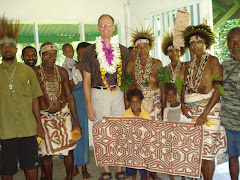
Daunted, we nevertheless proceeded: thurifer, crucifer, torchbearers, Archbishop and friars in high church Anglican regalia. Everyone else in feathers and leaves and bits of bark, including two young women attendants for the Archbishop. Br. Charles wore a magnificent crown fashioned from the beaks of the Horned-Bill (?? that's what they told me--some kind of big bird) and feathers from a casuary bird. "It's probably the only moment of glory you'll ever get," the Archbishop quipped. "Enjoy it." He was escorted up to the Archbishop by his father's youngest brother. I spoke, trying not to make too many parenthetical remarks and unnecessary stories which is my default mode when I am trying to think of something to say. Not much needed to be said, as everybody was goggle-eyed at the thought of a man making a life profession of vows of poverty, chastity and obedience--no different from a crowd of teary aunts and cousins in New York, I thought. Nobody is too sure it is really the best idea but everybody wants to be in the spirit of the day. I hit joy, love and gratitude really hard.
The deed was done and we departed the by now steamy structure, rain having given way to full sun. I was not prepared for what greeted us at the door of the church: a pig trussed on a pole, laid on the ground; I was walking with the bishop and before I knew it an axe was buried in the pigs head, blood spraying everywhere. The people shouted and danced with joy. Swallowing hard, I walked along. It happened two more times. That was the moment I felt light years from home.
And yet the only reason I was there was because the same Gospel inspired me as it has Charles. The same stories of St. Francis, and friendship with a band of brown-robed men of every race and language and people and nation.
Won't you come and join our happy crew?
Saturday, June 19, 2010
A Visit to Walsingham
I have been curious about Walsingham for a long time. In 1982 I was introduced to Our Lady of Walsingham in a New York City parish. Urban decline had robbed her of her fleur-de-lys staff and she had a sheen of city grime, and I felt the whole business of an English Nazareth pretty far away and irrelevant. In those days, the parish was championing the cause of those opposed to the ordination of women so I rather lumped Our Lady of Walsingham into that camp, never kissing her image as some enthusiasts did.
But then I met some people who were as liberal as me (!) and held deep affection for all that Walsingham is about. So I have had a desire to get there and see for myself. A year or so ago SSF established a tiny friary there, and this year, during my visit to the European Province I made a point of going to Walsingham. Below are Brothers Paschal and Maximilian in front of the Shrine of Our Lady of Walsingham.

It is picture perfect, and early summer is the best time to see the beautiful gardens. I stayed in the bedroom used by the founder of the modern Shrine Fr. Hope Patten (upstairs in this house).

Yes, there are lots of people opposed to the ordination of women in Walsingham. But there were some women priests there, though not celebrating Mass. There were lots of school children and people of various races and social backgrounds. I had a chance to talk with the Warden, Bishop Lindsey, and he was quite emphatic in refuting my prejudices about Walsingham.
So, yet again I had to re-consider things. My spiritual journey has a well established pattern of adamantly held opinions gradually eroded away through exposure and prayer. I have an Anglican fault in that I make snap aesthetic judgments, and I can get quite worked up about "good taste." I didn't like the paintings in the Shrine so was ready to dismiss the whole thing. But then a small voice advised me to pray not criticize.
Sometimes I got a bit of a headache from all the prayer as thing after thing bothered me. Until I decided to live and let live. "Don't let it bother you, so!" I could friends' voices in my head.
In spite of myself I enjoyed the procession around the Shrine gardens during the evening, carrying candles aloft. Everytime we sang "Hail Mary" we hoisted the candles above our heads. I remembered our torchlit labyrinth walks at Little Portion Friary, and all the people from every faith and background who joined us on those pilgrimages round and round the labyrinth.

One of the themes that kept getting emphasized: "What has Our Lady given you in your pilgrimage visit?"
I wanted to disclaim: "I'm just here to visit the brothers! Not a pilgrimage!" But my journal is full of notes from a book I was reading at the time called "Reshaping Ecumenical Theology." I was especially intrigued with the idea of "reception." And the magazine on top of the shifting mound of papers in the brothers' common room in the friary had a long and helpful article about reception by Dame Mary Tanner--a theologian I respect. So I decided that this is what Our Lady had to teach me. Reception is the process by which the church welcomes change: slowly, and marked by integrity, humility and spiritual maturity. I read about the hundreds of years it took the Church to accept the Nicene Creed. Obviously it is about not jumping to conclusions, making snap judgments, adopting either/or, black/white positions. I thank God I am not an ecumencial officer of any denomination; but I am every day asked to give an account of the faith that is in me. If I hurt others, or diminish them, or write them off I am only demonstrating the insufficiency of my love and intellectual and spiritual stamina. To give up on other people is a sin.
Thank you Mary.
But then I met some people who were as liberal as me (!) and held deep affection for all that Walsingham is about. So I have had a desire to get there and see for myself. A year or so ago SSF established a tiny friary there, and this year, during my visit to the European Province I made a point of going to Walsingham. Below are Brothers Paschal and Maximilian in front of the Shrine of Our Lady of Walsingham.

It is picture perfect, and early summer is the best time to see the beautiful gardens. I stayed in the bedroom used by the founder of the modern Shrine Fr. Hope Patten (upstairs in this house).

Yes, there are lots of people opposed to the ordination of women in Walsingham. But there were some women priests there, though not celebrating Mass. There were lots of school children and people of various races and social backgrounds. I had a chance to talk with the Warden, Bishop Lindsey, and he was quite emphatic in refuting my prejudices about Walsingham.
So, yet again I had to re-consider things. My spiritual journey has a well established pattern of adamantly held opinions gradually eroded away through exposure and prayer. I have an Anglican fault in that I make snap aesthetic judgments, and I can get quite worked up about "good taste." I didn't like the paintings in the Shrine so was ready to dismiss the whole thing. But then a small voice advised me to pray not criticize.
Sometimes I got a bit of a headache from all the prayer as thing after thing bothered me. Until I decided to live and let live. "Don't let it bother you, so!" I could friends' voices in my head.
In spite of myself I enjoyed the procession around the Shrine gardens during the evening, carrying candles aloft. Everytime we sang "Hail Mary" we hoisted the candles above our heads. I remembered our torchlit labyrinth walks at Little Portion Friary, and all the people from every faith and background who joined us on those pilgrimages round and round the labyrinth.

One of the themes that kept getting emphasized: "What has Our Lady given you in your pilgrimage visit?"
I wanted to disclaim: "I'm just here to visit the brothers! Not a pilgrimage!" But my journal is full of notes from a book I was reading at the time called "Reshaping Ecumenical Theology." I was especially intrigued with the idea of "reception." And the magazine on top of the shifting mound of papers in the brothers' common room in the friary had a long and helpful article about reception by Dame Mary Tanner--a theologian I respect. So I decided that this is what Our Lady had to teach me. Reception is the process by which the church welcomes change: slowly, and marked by integrity, humility and spiritual maturity. I read about the hundreds of years it took the Church to accept the Nicene Creed. Obviously it is about not jumping to conclusions, making snap judgments, adopting either/or, black/white positions. I thank God I am not an ecumencial officer of any denomination; but I am every day asked to give an account of the faith that is in me. If I hurt others, or diminish them, or write them off I am only demonstrating the insufficiency of my love and intellectual and spiritual stamina. To give up on other people is a sin.
Thank you Mary.
Sunday, June 13, 2010
Visiting Alnmouth

Alnmouth is a tiny village in the far north of England, not far from Scotland. The brothers have lived here, in a rehabilitated house for a long time. I say "rehabilitated" because after it's salad days as a luxury home it became a night club ("and worse" as late Brother Edward might have said). You can just speculate about that...
As a friary it has been the staging area for missions throughout the North of England. Brothers are always coming and going out from this place, and it has hosted thousands of people seeking peace and quiet to sort through their life and vocation. Perched over the sea side it is a perfect place for mulling over the meaning of life.

But the friars don't let much moss grow on their feet. They are a busy lot, five of them hosting a steady stream of guests--cooking, cleaning, offering beautiful worship and attentive hospitality. The Franciscan flavor of it all is that there is no separation between guests and brothers. No separate guest house, no separate dining room, everyone included in the prayers and chapel life.
 Sometimes of course it can be a bit much, but as elegant as the surroundings are, it is all about poverty: no control over much of life, having to accept and thrive in the circumstances where we find ourselves, offering to God our longing to run away from it all and finding grace to be gracious--yet again and again. I admire all that they do.
Today, Sunday, we are getting ready for the annual Garden Open Day sponsored by the Rotary Club in the village. Rotarians are everywhere erecting tents and different games. It is a money making day to support various local charities. It's raining but everybody still expects a good turnout, as the English never let a bit of rain spoil their fun! The friars collaborate with the Rotary Club by offering the beautiful gardens as the site. So I have spent the week gardening: mowing the lawn, weeding, sweeping. I find these kinds of activities deeply healing, transporting me back to my adolescence when I worked as a lawn boy and all around jack-of-all-trades for various people. I lose myself in a dreamy state of mind, moving to rhythms of lawn mower and broom, bending, lifting, praying and giving thanks. Sometimes people express concern for my "busy life" not knowing it is only busy on paper. The actual living of it is slower than most peoples' lives. The only sacrifice is stability.
But what mendicant wants THAT?
Sunday, June 6, 2010
Praise the Lord!
This morning we heard a rousing homily from a brother from Belfast on the need to praise God. It certainly captured my mood. There is much to be thankful for: a terrific week of meetings here at Hilfield Friary in Dorset, England, not forgetting beautiful weather (always remarkable here in England). The people, the setting, the sense of new things happening has inspired me.
The week began with a pilgrimage from the local nearby parish in Cerne Abbas to the friary. It is a yearly event, and very neighborly. About 40 people walked through the stunning countryside. Great fun, and a chance to show off their dogs,
the event is truly a pilgrimage, a visit to a holy place. The walk is punctuated with scripture reflections, and upon reaching the friary, a huge "cream tea" is set out, a collaborative effort between the parish and friary community featuring cakes and sandwiches. The event culminates in a lovely Evensong.

The theme of pilgrimage continued into the meetings during the week. The brothers had an historic meeting here, in which they decided to have an annual all brothers' Chapter. There was a strong sense that it was time for such a development in the province, and the brothers are eager to see this happen. As one brother pointed out, the community has traveled a long way, andenjoyed the guidance of the Holy Spirit. There is a high level of enthusiasm for sharing the responsibilities in the province. I was deeply moved by the seeming transformation among the group as they met in small groups and then came back to the plenary sessions eager to move forward. I was braced for cynicism, but there was none of it. The facilitator listened particularly well, and skillfully named the deepest longings of the group and framed the discussion. A very heartening process.
But it hasn't been only about the meetings. The community at Hilfield has also continued to develop and proceed on it's pilgrimage together. Both friars and other people have been living together at the friary, and it is great to see the things that were talked about before actually happening! The sheep are lambing, chickens are laying, the garden is growing. Patches of lawn are given over to wildflowers, encourage different insects. It really is about a conversion, learning to see and value things differently. I love neatly tended lawns but they are not always the most helpful to the ecosystem.
The Community of St. Francis, our First Order Sisters, are moving out of Compton Drville, their huge old manor house in Somerset. They are moving to much smaller premises. During a break in our Joint Chapter we moved some furniture out. The tone deaf piano enjoyed a last hurrah curbside.
The week began with a pilgrimage from the local nearby parish in Cerne Abbas to the friary. It is a yearly event, and very neighborly. About 40 people walked through the stunning countryside. Great fun, and a chance to show off their dogs,

the event is truly a pilgrimage, a visit to a holy place. The walk is punctuated with scripture reflections, and upon reaching the friary, a huge "cream tea" is set out, a collaborative effort between the parish and friary community featuring cakes and sandwiches. The event culminates in a lovely Evensong.

The theme of pilgrimage continued into the meetings during the week. The brothers had an historic meeting here, in which they decided to have an annual all brothers' Chapter. There was a strong sense that it was time for such a development in the province, and the brothers are eager to see this happen. As one brother pointed out, the community has traveled a long way, andenjoyed the guidance of the Holy Spirit. There is a high level of enthusiasm for sharing the responsibilities in the province. I was deeply moved by the seeming transformation among the group as they met in small groups and then came back to the plenary sessions eager to move forward. I was braced for cynicism, but there was none of it. The facilitator listened particularly well, and skillfully named the deepest longings of the group and framed the discussion. A very heartening process.
But it hasn't been only about the meetings. The community at Hilfield has also continued to develop and proceed on it's pilgrimage together. Both friars and other people have been living together at the friary, and it is great to see the things that were talked about before actually happening! The sheep are lambing, chickens are laying, the garden is growing. Patches of lawn are given over to wildflowers, encourage different insects. It really is about a conversion, learning to see and value things differently. I love neatly tended lawns but they are not always the most helpful to the ecosystem.
The Community of St. Francis, our First Order Sisters, are moving out of Compton Drville, their huge old manor house in Somerset. They are moving to much smaller premises. During a break in our Joint Chapter we moved some furniture out. The tone deaf piano enjoyed a last hurrah curbside.
Saturday, May 22, 2010
We have had quite a busy few days: and Chaper is not even half over. Here we are all pictured with the Bishop of Long Island after Mass on Friday

One of the first things we did was to welcome our new novice, Br. James-Paul

Sister Jean, Minister Provincial of CSF spent a couple hours knotting the new ropes for the four brothers who were professed today.

At noon today, Br. Jude, the Minister Provincial of the Province of the Americas opened the liturgy where we professed four brothers; it has been many years since we professed four men at once.

From right to left, we professed Brother James, Brother Maximilian Kolbe, Brother Ambrose Cristobal, and Brother Simon. Pictured at the far left of the photo is Brother Jacob, one of our first year novices.

Here the Brothers are signing the documentation of the vows they have made.

Following the Profession (with an amazing sermon by Br. Richaard Jonathan the Novice Guardian, we all went upstairs for a terrific Mexican lunch of soup, salad and tamales! There was a huge cake.
And then it was back to work in the Chapter room; what an exceptional day it has been.
Thanks be to God!

One of the first things we did was to welcome our new novice, Br. James-Paul

Sister Jean, Minister Provincial of CSF spent a couple hours knotting the new ropes for the four brothers who were professed today.

At noon today, Br. Jude, the Minister Provincial of the Province of the Americas opened the liturgy where we professed four brothers; it has been many years since we professed four men at once.

From right to left, we professed Brother James, Brother Maximilian Kolbe, Brother Ambrose Cristobal, and Brother Simon. Pictured at the far left of the photo is Brother Jacob, one of our first year novices.

Here the Brothers are signing the documentation of the vows they have made.

Following the Profession (with an amazing sermon by Br. Richaard Jonathan the Novice Guardian, we all went upstairs for a terrific Mexican lunch of soup, salad and tamales! There was a huge cake.
And then it was back to work in the Chapter room; what an exceptional day it has been.
Thanks be to God!
Wednesday, May 19, 2010
Pay Attention!

One of the keys to a happy life is to pay attention to people and circumstances. Tripping obliviously along does not bode well for the spiritual life either.
But I don't always pay attention. Sometimes it is because I am tired. Other times I don't pay attention because what needs attending to is beyond my ken and unavailable to me.
For instance, Saturday I was returning from a short run and, relishing the golden sun on Mt. Sinai harbor, I decided it would be the perfect evening to inaugurate the canoe for this season. Br. Max was willing, so we wrestled the craft upside down onto our shoulders, hiding our heads, and bumbled like an enormous sow bug down the hill from Little Portion to the little bit of marsh which is our "beach." Cars slowed way down when they saw the four-legged green thing alongside the road.
We opted for the shortcut to the harbor, and blundered through sticker bushes, over fallen logs and through sharp bladed grass. Finally we reached the harbor.
"Uh-oh," said Max.
"What's wrong?" I asked peering from beneath the canoe.
"Tide's out."
"The tide?!" I stammered. "I never thought of that."
Being naturally impatient I tried to slog through the mud and grass to reach the water. Max held back, laughing. I sank up to my knees in viscous, odoriferous muck, only saving my shoes by clenching my toes tightly. I admitted defeat.

"But I am not carrying this thing back up the hill until we get out on the water," I vowed.
So we stashed the canoe in a bramble thicket, deciding that nobody would be inclined to grapple with it and the menacing vegetation. And if they were, they would be welcome to the boat.
Sunday Br. Derek announced: "High tide at 12:45." We were learning to pay attention to new things.
Unsurprisingly, the canoe was still there. We slid it easily into the water and glided out across the grasses to the open water--several feet above the muddy sea floor. There is a line in Kenneth Grahame's "Wind in the Willows" at the very beginning, when Water Rat says to Mole as they set out in a boat: "Believe me, my young friend, there is nothing--absolutely nothing--half so much worth doing as simply messing about in boats. Simply messing," he went on dreamily: "messing--about--in--boats; messing--" So begin their adventures and misadventures together. Reading them today I am reminded of the friars sometimes. But that line of Water Rat's has stayed with me from childhood. It expresses the epitome of pleasurable leisure.

So we paddled lazily, sometimes bumping into things, watching egrets, herons, ducks, geese and swans. Max saw a school of fish. We marveled at a jelly fish. We speculated on the happiness of the people who lived in the huge water-side mansions compared with ourselves in our canoe. Surprisingly (but why should it have been?), we knew some folks on one of the lobster boats and shouted greetings.
"Look at that!"
"Look at that over there!" we told each other. There was much to see and pay attention to.

Sometimes being told to "pay attention" can be threatening or chastening. But as we prepare for Pentecost this Sunday, it can be an invitation too. Consider yourself invited to take note of the breath-taking beauty around you, unimagined riches right in our back yards.
Alleluia. The Spirit of God fills the whole earth; holy widsom, herself unchanging, in Christ makes all things new. Alleluia.
Subscribe to:
Posts (Atom)