Today I leave for Nyack, NY, to the headquarters of The Fellowship of Reconciliation for a short orientation before we leave for Iran Wednesday night. The past few days since my return from London Saturday have been busy; but the frosting on the cake was learning that UPS had not picked up my passport from the store I’d mailed from with overnight postage to get the visa. Learning this Monday, about 11:00 a.m., I rushed to the store and picked up the passport (forfeiting the $25.00 postage!). The challenge then was to find a way of getting the passport to the courier who would take it to Washington D.C. The man lives in Albany, I was in Port Jefferson, about 7 hours away. After several phone calls we decided I’d meet him in Nyack at 2:00. So I drove the 2+ hours to Nyack, getting there a quarter of an hour before the courier arrived!
Slouched in a chair in Nyack, resting, I learned that not every member of the delegation had received visas. The Iranians delayed until yesterday morning to issue visa numbers from Tehran, and they denied 4 members of our delegation; two others have not yet received numbers but indications are that they will in due course. What a shock! There is no apparent reason or pattern to the decision as the four include Jews and Muslims, male and female, experienced travelers to Iran, and first-timers. We may never learn; this is the way it is traveling to Iran.
This reality check will be the background to the work we do. I believe it will be important to let go of the anger and disappointment, and try to meet the people with open hearts and minds. Yet our governments are not in synch. They are suspicious of Americans and America is suspicious of Iran. The only way to dissolve the suspicion and the jostling for power is to talk, to reach across the divide and make relationships. Other delegations have made tremendous contacts, and the reports we read are that “ordinary” Iranians are enthusiastic about meeting Americans, dismayed by the nuclear competition.
Tuesday, November 25, 2008

Saturday, November 22, 2008
Preparing for Peace
I've been in London this week working on a proposal for a formation program which is intended for the brothers and sisters who will be working with our novices. It has been a great experience to work on this proposal: engaging in conversation with my colleague Sister Joyce, the Minister General of the Sisters of the Community of St. Francis, thinking, praying, and dreaming about the best way to empower our communities. I spent a happy day trolling the internet reading websites and seeing how what we hope to do might interface with what people are doing in the New York area. I came across a website with a program title: "Formators as transformative agents" by Don Bisson: this is exactly what we hope to be about! Not only do I hope the formators--the people who teach the novices--should be transformative agents, but all of us.
The other thing going on this week has been the increasingly intense preparations for my trip to Iran next Wednesday. I go as an agent of transformation, working for peace. In a way it is a chance to do the kind of thing Joyce and I have been talking about in terms of preparing the novices to do.
Sturggling to get over my jet lag I have had several weird hours of wakefulness, which I have used to read about Iran. My current late night primer is about the President of Iran: "Ahmadinejad: The Secret History of Iran's Radical Leader" by Kasra Naji. If ever there was a need to hear two sides of a story and to create bridges of friendship and understanding between two peoples, i think Iran is the perfect place to go. The language is so hyperbolic. So I have had to do some preparatory work thinking and praying about the best way to meet and relate with people in a culture and context very different from mine.
I am reminded of St. Francis and how he went among the Muslims. He went, refusing to preach much with words, but to live in such a way as to invite people to approach him with questions. I like this model of approachability, and hope I can present myself in that way.
I am in a hurry to get to Heathrow to catch a flight to New York. But as i go, i feel that it is all about peace, all about friendship, all about deeper understanding.
The other thing going on this week has been the increasingly intense preparations for my trip to Iran next Wednesday. I go as an agent of transformation, working for peace. In a way it is a chance to do the kind of thing Joyce and I have been talking about in terms of preparing the novices to do.
Sturggling to get over my jet lag I have had several weird hours of wakefulness, which I have used to read about Iran. My current late night primer is about the President of Iran: "Ahmadinejad: The Secret History of Iran's Radical Leader" by Kasra Naji. If ever there was a need to hear two sides of a story and to create bridges of friendship and understanding between two peoples, i think Iran is the perfect place to go. The language is so hyperbolic. So I have had to do some preparatory work thinking and praying about the best way to meet and relate with people in a culture and context very different from mine.
I am reminded of St. Francis and how he went among the Muslims. He went, refusing to preach much with words, but to live in such a way as to invite people to approach him with questions. I like this model of approachability, and hope I can present myself in that way.
I am in a hurry to get to Heathrow to catch a flight to New York. But as i go, i feel that it is all about peace, all about friendship, all about deeper understanding.
Monday, November 17, 2008
Trust
Yesterday I heard a great sermon by Phil Brochard, rector of All Souls Episcopal Church in Berkeley about trust. You can get a copy of it by e-mailing allsouls@allsoulsparish.org or maybe check their website: www.allsoulsparish.org I won’t re-hash it here, but it got me to thinking about whether or not I live trustfully. Do I trust myself? Do I trust the people I am traveling to Iran with? Do I trust my brothers?
Most of the time.
Another way of thinking about trust, for me, is to think about letting go. I have to let go of my fears, let go of my desire to control the outcomes of my interactions, and life transactions. I need to do my best and leave the rest up to God: trust God.
Sometimes trust gets a body blow: I got two of these last week.
The first challenge to trust was the destruction of the Order of Holy Cross Monastery in Santa Barbara. You never know when natural disaster will strike. My mind immediately starts to calculate risks. One can never be too safe; it is a thin line to cross over to “trust nobody” you are never totally safe. Of course I know life is a series of calculated risks, most of which we hardly acknowledge: crossing the road, driving on a free way, taking an airplane ride, which I do continuously without a second thought. Well, I have been having a lot of second thoughts since the fires in Santa Barbara.
The second blow was the report of the racist attack on a migrant worker on Long Island by a self-styled KKK group. They killed him, and left handbills threatening other “non-whites.” A friend attributes it to a backlash against Barack Obama’s election. To live trustfully in a democracy one must believe that people will obey laws and respect each other. Many of the migrant workers on Long Island are men and women I know. They catered the meal after my installation as Minister General last November. Racist attacks spoil the atmosphere of trust and harmony and weaken our society.
So I have taken these incidents as the starting place for my prayers each morning: affirming my trust in God, seeking to open my eyes to perceive the hand of God at work in the world around me. I try to notice the beauty of nature even as I recognize the fires are tragedies for my friends. I marvel at the many friends I have of every race and creed. Crucial for me is not to lapse into all-or-nothing thinking, taking a tragedy and replicating it everywhere in my imagination: “catastrophizing” as one friend calls it. Remembering these things clears my mind; I can sign a petition against racism, I can make calls and try to organize help for Santa Barbara. We are in solidarity with each other in good times and bad.
In God we trust.
Most of the time.
Another way of thinking about trust, for me, is to think about letting go. I have to let go of my fears, let go of my desire to control the outcomes of my interactions, and life transactions. I need to do my best and leave the rest up to God: trust God.
Sometimes trust gets a body blow: I got two of these last week.
The first challenge to trust was the destruction of the Order of Holy Cross Monastery in Santa Barbara. You never know when natural disaster will strike. My mind immediately starts to calculate risks. One can never be too safe; it is a thin line to cross over to “trust nobody” you are never totally safe. Of course I know life is a series of calculated risks, most of which we hardly acknowledge: crossing the road, driving on a free way, taking an airplane ride, which I do continuously without a second thought. Well, I have been having a lot of second thoughts since the fires in Santa Barbara.
The second blow was the report of the racist attack on a migrant worker on Long Island by a self-styled KKK group. They killed him, and left handbills threatening other “non-whites.” A friend attributes it to a backlash against Barack Obama’s election. To live trustfully in a democracy one must believe that people will obey laws and respect each other. Many of the migrant workers on Long Island are men and women I know. They catered the meal after my installation as Minister General last November. Racist attacks spoil the atmosphere of trust and harmony and weaken our society.
So I have taken these incidents as the starting place for my prayers each morning: affirming my trust in God, seeking to open my eyes to perceive the hand of God at work in the world around me. I try to notice the beauty of nature even as I recognize the fires are tragedies for my friends. I marvel at the many friends I have of every race and creed. Crucial for me is not to lapse into all-or-nothing thinking, taking a tragedy and replicating it everywhere in my imagination: “catastrophizing” as one friend calls it. Remembering these things clears my mind; I can sign a petition against racism, I can make calls and try to organize help for Santa Barbara. We are in solidarity with each other in good times and bad.
In God we trust.
Monday, October 27, 2008
Two New Provinces

I have been beyond the reach of electricity for much of the last six weeks: thanks for the concern some of you have expressed!
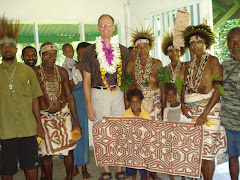
But it has been a really great time. I had to go to the Solomon Islands in September to preside at a special chapter for the drafting of Provincial Statutes and the election of a new Minister Provincial (see brothers celebrating at Hautambu at right); then I did the same in Papua New Guinea in October.
Frankly I was dreading the drafting of statutes. Whenever reference was made to statutes in the past I felt a sense of frustration, as if looking at statutes was the court of last appeal, a sign of imaginative failure. Here I was to be the prime mover in a writing exercise with a large group of men who rely more on an oral tradition, and by their own admission never felt the lack of a statute to be of any importance! What goes around comes around as they say… At left
 the PNG brothers prepare to write statutes!
 But we plunged in nevertheless, willing to be obedient to the SSF Constitution. I quickly discovered that what we were doing was writing a story about their life in the province. Every rule rests on the collected memories of the brothers about things that have worked in the past, and of course the things that didn’t work. The areas of confusion and frustration in their common life got aired and we made a stab at giving direction to ourselves in areas like when there is a breakdown in relationships in the community.
Interestingly enough, the two hottest topics in both chapters were the age of admission and issues surrounding the uniform. Most of the life professed brothers in both provinces joined when they were teenagers, and are now in their thirties or older. But they had painful stories of other men who joined with them and then left. So we thought about making the earliest age quite old: thirty was the first age suggested by both groups! But then as we talked about it the age came down, to 22 (Solomon Islands) and 20 (Papua New Guinea). Determining an age is a bit of a shot in the dark anyhow: without birth certificates most brothers choose October 4 (St. Francis’ Day) as their birthdays when they get their passports, and memories are hazy as to the year, and usually tied to a significant event: a storm or death in the family. But all they need is a letter signed by two village members agreeing how old they are. Age we realized wasn’t the central issue, but rather readiness to test a vocation. They will never preempt the pain of beloved friends leaving community to get married or do other things.
Uniforms are worn in both provinces because it is too hot to wear the habit all of the time and there is a big need, culturally, for the members of the religious orders to be easily identifiable. Some wanted to do away with the uniform idea altogether, others wanted brothers to wear it all of the time. Again more stories, careful listening, choosing a way forward. Halfway through my first chapter, in the Solomon Islands, I was fascinated by the discussions. In neither case did the brothers speak eagerly. It seemed as if they were reluctant to speak or had no opinion. But I soon discovered that idea was only my own impatience. As facilitator I soon realized my job was to keep the discussion “open” until everybody had a chance to speak or indicated he didn’t want to speak. They spoke obliquely, not confronting each other. Yet they had quickly realized that much of the frustration they’d encountered in past years was because they had not had the opportunity to fully discuss these questions, and they had relied on a cultural model of the leader deciding all instead of the Franciscan model of the Chapter making the decisions.
These Chapters were an awakening for all of us. There was palpable relief as issues were brought up and discussed. Frequently brothers would say “I wish we’d known this when…” There grew a sense of power as chapter members, perhaps empowerment is a better word. All of us found ourselves talking about statutes during the coffee breaks with more energy than ever before in our lives. These brothers, the survivor Life Professed and leaders of the two new provinces, were able to tell of their love for each other and their way of life as friars.
It was an honor to talk about statutes with them.
The election of the ministers provincial had a certain amount of drama: singing the Veni creator spiritus in a woolen habit, kneeling on a graveled chapel floor during a tropical rainstorm made me think of certain scenes in the film The Mission. It took several ballots in both cases, and in neither case did the brother elected really expect it. George looked as if he’d been bitten by a snake, and I had had to convince Laurence (the outgoing Regional Minister) to change his travel plans because he’d wanted to go home quickly, thinking his time as leader was over. George recovered his usual poise quickly, and Laurence seemed more relaxed, perhaps deeply affirmed.
Anglican Melanesian Franciscanism: it’s a mouthful, it is a reality, and now it is written down.
Monday, September 22, 2008
Traveling Trials
Acceptance, acceptance, acceptance: these are the three most important words when traveling in the Solomon Islands. Otherwise I become frustrated, enraged and demoralized. Every leg of my journey on domestic flights has been delayed sometimes by a few hours, but twice now by days at a time.
We arrive at the airport, check-in, and wait. Sometimes the plane comes, sometimes it doesn’t. If it comes, it may re-fuel and take passengers, or the crew may decide to shut down and the flight is cancelled.
Until when? This is the information most of us want.
“Mi no save,” is the airline attendant’s response (“I don’t know”). Call tomorrow. Sometimes the airlines personnel is too shy to come tell the passengers the bad news, so it is only after hours of waiting that a passenger sidles into the restricted area and learns the truth. Phone calls and personal visits to the airlines produce varying results. The airlines will often put out a time for the new departure, then immediately amend it. Sometimes the new time is earlier, other times it is later. What is often not explained is that they occasionally take passengers in order of precedence. If your flight was cancelled Saturday you get to fly on Monday. The Monday people must wait until Tuesday, or maybe Saturday because Tuesday they might not have a flight. But it also may be that they decide to honor today’s reservations and squeeze in the frustrated passengers from the earlier cancelled flights. Returning from Temotu, so many people were demanding to be allowed to fly the airlines decided yes, they could go, but none of their luggage. That would come another day. Maybe this week, maybe next week, depending on how much luggage the people on the next flight carried.
So it always pays to have plan B. Carry a book to read, something to eat. Leave on good terms because you might be returning home with your hosts again. Pack the bare minimum, preferably only take a small back pack or pouch so you can keep your stuff with you. Above all, don’t schedule things too tightly. Everybody needs a week or so of latitude. If you are making an international connection, start trying to get to Honiara a week early. Make open-ended room reservations.
Travel by ship is even more fraught. I’ve waited three days for a ship which was to return “tomorrow.” Brothers have waited two or three months in Honiara for ships going to the provinces. And if you are hoping to board a ship to town from a province, it may come or it may not come.
I have become a believer in competition. If there were another airline serving the same routes, I bet the service would be better. But one government airline, one government phone company leads to a Graham Greene kind of tropical bureaucratic tangle. I used to think his novels were so romantic. They still are, but it is different being the character in one versus reading about the poor hapless people caught in these situations.
I’ve complained. I’ve gotten angry. Nothing works: there are some things in life one has no control over. And every delay has held its own reward: conversations with fellow passengers, especially children. Maybe it is a chance to go for one more swim in the lagoon. Or I am rewarded with a heart-to-heart chat with a brother when every sort of conventional conversation has run dry, and we know everything there is too know about family, schooling, jobs, etc. We can finally talk about our hopes and fears. Sometimes I just “go native” and sit, watching all that is going on around. I think “wait” is an active verb for the Solomon Islanders. Much of life is spent waiting, and how you wait is very important. One doesn’t want to be so frenzied that the day is spoiled, or you hurt the people near you. Nobody in the waiting area has any more control over the situation.
And eventually you will get there. “Every some-ting come up for good” as they say here.
We arrive at the airport, check-in, and wait. Sometimes the plane comes, sometimes it doesn’t. If it comes, it may re-fuel and take passengers, or the crew may decide to shut down and the flight is cancelled.
Until when? This is the information most of us want.
“Mi no save,” is the airline attendant’s response (“I don’t know”). Call tomorrow. Sometimes the airlines personnel is too shy to come tell the passengers the bad news, so it is only after hours of waiting that a passenger sidles into the restricted area and learns the truth. Phone calls and personal visits to the airlines produce varying results. The airlines will often put out a time for the new departure, then immediately amend it. Sometimes the new time is earlier, other times it is later. What is often not explained is that they occasionally take passengers in order of precedence. If your flight was cancelled Saturday you get to fly on Monday. The Monday people must wait until Tuesday, or maybe Saturday because Tuesday they might not have a flight. But it also may be that they decide to honor today’s reservations and squeeze in the frustrated passengers from the earlier cancelled flights. Returning from Temotu, so many people were demanding to be allowed to fly the airlines decided yes, they could go, but none of their luggage. That would come another day. Maybe this week, maybe next week, depending on how much luggage the people on the next flight carried.
So it always pays to have plan B. Carry a book to read, something to eat. Leave on good terms because you might be returning home with your hosts again. Pack the bare minimum, preferably only take a small back pack or pouch so you can keep your stuff with you. Above all, don’t schedule things too tightly. Everybody needs a week or so of latitude. If you are making an international connection, start trying to get to Honiara a week early. Make open-ended room reservations.
Travel by ship is even more fraught. I’ve waited three days for a ship which was to return “tomorrow.” Brothers have waited two or three months in Honiara for ships going to the provinces. And if you are hoping to board a ship to town from a province, it may come or it may not come.
I have become a believer in competition. If there were another airline serving the same routes, I bet the service would be better. But one government airline, one government phone company leads to a Graham Greene kind of tropical bureaucratic tangle. I used to think his novels were so romantic. They still are, but it is different being the character in one versus reading about the poor hapless people caught in these situations.
I’ve complained. I’ve gotten angry. Nothing works: there are some things in life one has no control over. And every delay has held its own reward: conversations with fellow passengers, especially children. Maybe it is a chance to go for one more swim in the lagoon. Or I am rewarded with a heart-to-heart chat with a brother when every sort of conventional conversation has run dry, and we know everything there is too know about family, schooling, jobs, etc. We can finally talk about our hopes and fears. Sometimes I just “go native” and sit, watching all that is going on around. I think “wait” is an active verb for the Solomon Islanders. Much of life is spent waiting, and how you wait is very important. One doesn’t want to be so frenzied that the day is spoiled, or you hurt the people near you. Nobody in the waiting area has any more control over the situation.
And eventually you will get there. “Every some-ting come up for good” as they say here.
Visit to Santa Cruz Island
I arrived in the Solomon Islands a week ago, September 16. Wednesday the 17th I flew to Lata, the provincial capitol of Temotu province. Holy Martyr’s Friary has been perched on a cliff overlooking an amazing lagoon with an active volcano in the background for about 10 years. Initially it was a house made of local materials: palm and bamboo with a few home-milled planks (made with a chainsaw). Gradually over the years the brothers and their friends have hauled concrete, lumber, masonite, corrugated iron roofing up the face of a slippery coral cliff and built a permanent building. As yet there is no electricity or running water, so life goes by different rhythms: sleep when its dark, then awake and working in daylight.
In the brothers’ prayers they always give thanks for the air they breathe, the water they drink and the food that God provides. I was struck by the appropriateness of these prayers: water comes straight from heaven and all they need to do is catch it in barrels. Food is available to anybody who can handle a hoe or spear, firewood is abundant in the forests. Abundance, yes, but at the cost of some hard work!
There is a large group of both men and women students at a nearby training school who have become Companions of SSF. In honor of my visit they decided to prepare a meal: sit down dinner for 50. So my first day we all armed ourselves with axes and attacked a dead tree like an army of ants, everybody chipping away and passing the chunks of wood down the line of workers to the friary. The next day Br. Ini went diving with a young man who aspires to be a friar, Morris. While they were away, Br. Martin and I split some firewood, swept the house and chapel. When the brothers returned with about 24 fish the Companions also showed up with bags of stones to use to build “ovens”—a layer of stones, then fire, with more stones on top (oven is ready to use when all the stones are hot). Leaving the stones, they headed out swinging their machetes, to collect banana and bread fruit leaves to cook with. Another crew headed to the Brothers’ gardens to dig potatoes: kumara and cassava. After re-grouping, they all went in search of coconuts up in the bush. On the third day—early in the morning (yes it does have paschal overtones) they returned [about one a.m.] to kill the pig, peel the roots and grate the coconut meat and build fires in the outbuildings to begin heating stones for cooking. In spite of heavy
rain and weak flickering light from kerosene lamps they were happy, going about their tasks singing and flirting with each other. By six a.m. the ovens were all sealed, with pig, fish, pudding and potatoes baking. We spent the day in near catatonia, until about 4:00 p.m. when they companions returned to put the finishing touches on the meal. At 5:00 everybody departed to get cleaned up, and they returned at 6:30 for an evening Eucharist lit by two flickering candles and a smoky oil lamp.
At Eucharist I preached homily about generosity. In the Epistle Paul wrote the Romans not to conform themselves to the way of the world, but to live differently, and that everybody has their role to play in the work of the Gospel; he exhorts people whose gift is to be a giver—to give generously. In the Gospel of John we heard about the generosity of God, who loved the world so much that he sent his only Son to live as one of us…living in the world as generous people we stand over against the way of the world which often promotes competition, winners and losers, people whose main concern is to protect themselves. I feel that the way of life these friars and students share is one which the world needs to emulate. Not the sweat and trouble of primitive living in a tropical jungle (though if you try it you might like it as much as I do), but of living in conscious reliance on the grace of God and interdependently with each other, seizing the opportunities to celebrate life. This is the Franciscan way.
After the Eucharist there was a lull while the team of servers put the food out on banana leaves on the floor of the dining room. Finally it was ready and we all pushed into the small dining hall and crouched on the floor over our pile of food. Food has rarely tasted so good! There were speeches, songs, prayers. Above us the stars shone intensely and a breeze tossed the tree tops.
In the brothers’ prayers they always give thanks for the air they breathe, the water they drink and the food that God provides. I was struck by the appropriateness of these prayers: water comes straight from heaven and all they need to do is catch it in barrels. Food is available to anybody who can handle a hoe or spear, firewood is abundant in the forests. Abundance, yes, but at the cost of some hard work!
There is a large group of both men and women students at a nearby training school who have become Companions of SSF. In honor of my visit they decided to prepare a meal: sit down dinner for 50. So my first day we all armed ourselves with axes and attacked a dead tree like an army of ants, everybody chipping away and passing the chunks of wood down the line of workers to the friary. The next day Br. Ini went diving with a young man who aspires to be a friar, Morris. While they were away, Br. Martin and I split some firewood, swept the house and chapel. When the brothers returned with about 24 fish the Companions also showed up with bags of stones to use to build “ovens”—a layer of stones, then fire, with more stones on top (oven is ready to use when all the stones are hot). Leaving the stones, they headed out swinging their machetes, to collect banana and bread fruit leaves to cook with. Another crew headed to the Brothers’ gardens to dig potatoes: kumara and cassava. After re-grouping, they all went in search of coconuts up in the bush. On the third day—early in the morning (yes it does have paschal overtones) they returned [about one a.m.] to kill the pig, peel the roots and grate the coconut meat and build fires in the outbuildings to begin heating stones for cooking. In spite of heavy
rain and weak flickering light from kerosene lamps they were happy, going about their tasks singing and flirting with each other. By six a.m. the ovens were all sealed, with pig, fish, pudding and potatoes baking. We spent the day in near catatonia, until about 4:00 p.m. when they companions returned to put the finishing touches on the meal. At 5:00 everybody departed to get cleaned up, and they returned at 6:30 for an evening Eucharist lit by two flickering candles and a smoky oil lamp.
At Eucharist I preached homily about generosity. In the Epistle Paul wrote the Romans not to conform themselves to the way of the world, but to live differently, and that everybody has their role to play in the work of the Gospel; he exhorts people whose gift is to be a giver—to give generously. In the Gospel of John we heard about the generosity of God, who loved the world so much that he sent his only Son to live as one of us…living in the world as generous people we stand over against the way of the world which often promotes competition, winners and losers, people whose main concern is to protect themselves. I feel that the way of life these friars and students share is one which the world needs to emulate. Not the sweat and trouble of primitive living in a tropical jungle (though if you try it you might like it as much as I do), but of living in conscious reliance on the grace of God and interdependently with each other, seizing the opportunities to celebrate life. This is the Franciscan way.
After the Eucharist there was a lull while the team of servers put the food out on banana leaves on the floor of the dining room. Finally it was ready and we all pushed into the small dining hall and crouched on the floor over our pile of food. Food has rarely tasted so good! There were speeches, songs, prayers. Above us the stars shone intensely and a breeze tossed the tree tops.
Saturday, September 13, 2008
Anti-malarials
Today I started my anti-malarial medication in anticipation of my trip to The Solomon Islands on Tuesday. I feel a bit queasy, but I know from experience this will pass. There are three recommended medications one can take which are supposed to inhibit malaria (none of them can actually guarantee you won’t get it, but they decrease the likelihood, so I take them). One of the recommended medications is called Larium; this is what the
But these are all the exigencies that go with the job and my ministry among and with my brothers from The Solomon Islands and
The most widespread (and effective) precaution is the use of sleeping nets. They are very cheap by Western standards, yet a serious expense for the Islanders. I am grateful for my net when I lie in bed listening to the mosquitoes in a holding pattern around me. There are organizations which distribute nets to people in the Pacific, South America, Africa, India and Asia: send money! Malaria is awful and a death sentence for babies.
But otherwise, everything is fine…
I have had a terrific time in  The roof leaks everywhere—not normally a problem in drought ridden
It is spring down here, and the wisteria came into full bloom outside my bedroom window.
Subscribe to:
Posts (Atom)