Wednesday, August 13, 2008

A Home near the DMZ


"Welcome to the Society of St. Francis" the sign says.

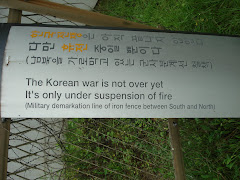
I arrived in Korea last night after a nearly 14 hour flight from Washington D.C. As we traveled back to the friary from the airport, Br. Christopher John was pointing out the various local attractions. One thing he said pierced my jet-lagged fugue state: “near the DMZ.” It turns out we are very near to the border. All day I have been thinking about how the brothers have placed themselves in an uncertain, in-between place. It is not as if they live on the Gaza strip or in Iraq, but just a month or so ago a tourist was killed at the border. It is still very difficult to travel; the friars helped to organize a peace pilgrimage to North Korea and all cell phones, cameras and laptops had to be left behind. The border and all that it means to the people of Korea is just “over there.”

This little friary seems to be part of the huge drama of the reconciliation of a people who have suffered for many years. Obviously, nearly all prayer and conversation is carried on in Korean, so any words in English stand out with a special vividness since I don’t understand any Korean. The three brothers have been reading the lessons at the daily office in English, which seems an incredibly generous thing to do. At any rate, this morning’s lesson was about the parents of Samson entertaining an angel of the Lord; they played an important part in the story of salvation by offering a simple meal. So the simple things can have the most far reaching impact.

The brothers’ prayers and welcome to men and women seeking a time and space for quiet seems all the more profound to me. There were three guests here when I arrived. Like most of our friaries around the world, there are usually a few people around. One of the essential pieces of being a peacemaker is to carry on living with integrity and joy and affirming life, welcoming people into clean and orderly spaces, and the humane routines of shared meals, silence, prayer, laughter. Franciscans seem to thrive in places like this. One of the things we talk about is that the witness of life is often more eloquent than words.

So today we shopped, ate lunch (walnut jelly and buckwheat noodles!) then went for ice cream (black sesame seed and walnut—walnuts play a big part in the local food), looked at dams, roads and lots of tunnels and other construction projects. The brothers shared a dislike for the construction boom, pointing out the encroachment on the rice paddies, the cheap and gaudy tourist facilities. And we told stories about our lives, our hope for the Franciscan community in Korea. I has been an incredibly rich and eloquent day.

Saturday, August 9, 2008

Ecumenical Dialogue


This week I traveled to Washington D.C. for a week of engaging conversations with some Roman Catholic Franciscans. The convener has been the Minister General of the Society of the Atonement, Br. Jim Puglisi, and there were representatives from the OFM’s and Capuchins as well as Sister Joyce, Minster General of my first order sisters in CSF, with Sr. Pamela Clare and Br. Cesar, SSF. There were 8 members all together. We were talking about ecumenism among Franciscans vis-à-vis our mission: the history of it, the way we teach new members about it, the spirituality behind it and how we can work together towards realizing even more connection between Anglican and Roman Catholic Franciscans.

I realized during the week that my whole ministry has been about making connections with people of different Christian traditions, in most cases trying to create momentum for helping the poor. Working together is not an “option”; it is absolutely necessary if we are to present the Christian Gospel with any kind of authority. But at the same time it is necessary to respect the differences among us. I had to let go of some resentments when they asked for blessings instead of receiving the Eucharist.

One of the greatest gifts God has given SSF, I realized again, is our small size. Our minority allows us a great freedom: freedom to try things, to change direction if we need to, freedom from always having to “get it right” and justify ourselves to a huge bureaucracy. But our freedom also has some pretty big responsibilities that come along with it: we are responsible for trying new things, imagining new ways to live, keeping our priorities on God, the Gospel and the people who come our way. And on loving each other; because we are so small it is possible to know every member of the order and to have a relationship with each brother, at least in prayer. That is how I understand part of my job: to know and love the brothers and sisters. Out of these relationships God will bring a new thing. We don’t need to know what it is, because if we did we might become fearful or anxious!

Growing in love for one another is of course what we did during this week. The difference between the first evening at dinner and tonight is remarkable. The first night the Anglicans sat at one end of the table, and the Roman Catholics sat at the other end. It was not intentional mind you, we simply sought out the people we knew and were comfortable with. Tonight we were all mixed together and the table was loud with laughter. The dining room crew was rattling their equipment to alert us to the late hour. Church unity doesn’t seem such a far fetched idea.

Sunday, August 3, 2008

Lambeth Conference celebrates conclusion


It is only Sunday morning, and the conference doesn’t end ‘til tonight, but already people are leaving. Like the Liturgy, it is very much “the Mass has ended, go in peace to love and serve the Lord.” There is a strong sense of having walked together, having learned much about each other. But now begins the harder work of taking the story back home to the people who were not part of the “process” and want results. Bishops must find a way to get people to talk to each other, and to engage with all the bishops who were not at Lambeth.

One bishop (unnamed) was quoted on the TV news as characterizing the conference as a “talkfest,” as if that were nothing. Watching the majority of the bishops engage in the process and listening to the way they interacted outside their group sessions, I would say something incredibly important happened. Again to cite my friendly author Alain de Botton, writing “On the Sublime” in his book The Art of Travel (he is paraphrasing the words and attitude of God speaking in Job): “Do not be surprised that things have not gone your way…the universe is greater than you. Do not be surprised that you do not understand why they have not gone your way, for you cannot fathom the logic of the universe. See how small you are next to the mountains. Accept what is bigger than you and what you do not understand. The world may appear illogical to you, but it does not follow that it is illogical per se. Our lives are not the measure of all things: consider sublime places for a reminder of human insignificance and frailty.” We have all been part of something much larger than our orders, parishes, dioceses or church provinces. All of us have had to develop a larger perspective than we came with. It has been bewildering at times, annoying (if not enraging) at times, and there have been times of incomparable sweetness in prayer, conversation, (and for me) long lovely runs through the English countryside. It amounts to a great deal.

Last night we had a plenary session with four stewards of the conference telling the bishops what they thought of Lambeth. They seemed to have had a good time. One of the bishops asked the representative stewards on stage what they hoped the Anglican Church would be like in thirty years (when some of the stewards might be sitting in the bishops’ places). I don’t know how I would have answered on the spot like that, but as I thought about it, I would hope that in thirty years a bishop’s sexual orientation will not be the cause of huge uproar. That the leadership of the Anglican Communion will be gay and straight, black and white, male and female from all across the globe, and we will be engaged in imaginative ministries, sharing the Good News in Word and deed, (and in thirty years time) able to celebrate a new global consciousness of how to live on the earth in harmony (an end to war), and as people in solidarity with the earth, having developed sustainable technologies and strategies and attitudes that heal and help the earth. I hope that people everywhere will have enough to eat, and able to live with dignity and joy; that children can grow up without fear.

Yesterday, I dog-eared a hymn we sang from our hymn book Lambeth Praise because it says much of what I carry away in my heart:

We cannot measure how you heal
or answer every sufferer’s prayer,
yet we believe your grace responds
where faith and doubt unite to care.
Your hands, though bloodied on the cross,
survive to hold and heal and warn,
to carry all through death to life
and cradle children yet unborn.

The pain that will not go away,
The guilt that clings from things long past,
The fear of what the future holds,
are present as if meant to last.
But present too is love which tends
The hurt we never hoped to find,
The private agonies inside,
The memories that haunt the mind.

So some have come who need your help
And some have come to make amends
As hands which shaped and saved the world
Are present in the touch of friends.
Lord, let your Spirit meet us here
To mend the body, mind, and soul,
To disentangle peace from pain
And make your broken people whole.

Words: John L. Bell (b. 1949) and Graham Maule (b. 1958)

Tune The Banks o’Doon (Ye Banks and Braes) Scottish folk melody harmonized by John L. Bell.

Friday, August 1, 2008

The twists and turns


I have been wondering how to characterize the last two days. Then yesterday I attended the blessing of the new labyrinth of the University of Kent. It is a beautiful labyrinth, and I found myself thinking about all the twists and turns life takes. I had a conversation with Gene Robinson (finally), and found myself admiring him for his courage to stand up and be himself, saying “I am the man” at the eye of the storm (as his book title has it). He has suffered a lot of criticism. Many people have sniffed that he is a “publicity hog” and opined he isn’t doing the gay cause any good. Yet as were reminded at the sermon at out opening Eucharist: "Social justice is monotonous." It requires tenacity, and in our world today, sophistication with the media. His photo was put into the guard booth at Canterbury Cathedral so if he were to try and get into the opening service he would be recognized and stopped. He is forbidden to meet with people at Lambeth except in pre-arranged venues. It makes me feel sick to my stomach that the Church feels it has to take such measures.

In general the approach to the media has been that they are the enemy. I can understand providing a safe place for the bishops, but there seems to be a profound distrust, and this is only exacerbating the negative coverage the Lambeth Conference seems to be getting, at least in the British newspapers.

Later on Thursday I attended a Healing of Memories workshop lead by Michael Lapsley. He is the director of the Institute for Healing of memories in Capetown, South Africa. Michael is an Anglican religious (provincial minister of the South African province of the Society of Sacred Mission –SSM). During the apartheid struggle he lost both of his hands when he opened a letter bomb. His story of his move from victim to victor is incredibly moving. He has taken his experience and turned it to gold, helping others to heal their memories and find freedom. Basically he operates on the principle that stories can heal. Even in our brief workshop we told a few stories. I know that in the bishops’ “indaba” groups, people are telling stories. But not all stories will be finished by the time we leave on Monday; I will need to process much of this when there is time…my next airplane ride!

But then at the reception held by the Bishops of the province of Papua New Guinea, we were all invited to stand and sing one of my favorite choruses: “We are one big, happy family, God’s family are we: she is my sister, he is my brother and God is our Father who loves you and me.”

Tuesday, July 29, 2008

Encounters with Sudan


I did meet a Sudanese Bishop yesterday.

I went to a Round table discussion about the Sudan, and listened to the heart wrenching accounts of Darfur and all of the incredible human needs in that country. The Archbishop made a strong plea for help from the world community; as I listened I thought: no matter what happens to the Anglican Communion I will do what ever I can to help the situation in Sudan. It is not about what the Sudanese bishops say or don’t say; the situation in Sudan is about me and God. There is a group called “Zero Church” (named after their street address, not a theological statement) which sings a song which says in effect, if people mock you for being honest, be honest anyway, if people reject you for the truth, tell the truth anyway, if people accuse you of profligacy, be generous anyway, because it’s not between you and them, but between you and God.

Feeling a bit more confident as I remembered my obligation to give my life over to the care and keeping of God, I knew I had to do my part and stick out my hand. So I approached a Bishop and introduced myself. I was feeling vulnerable and still angry about the things I’d read in the paper about the Archbishop of the Sudan calling for Gene Robinson to resign and suggesting, if not threatening, to break communion with the Episcopal Church. We shared a few home truths about the situation from our different perspectives and I was beginning to feel dismayed by the whole conversation, when the bishop told me to pray about it. I seized his hand and said: “Let’s pray now!” And so we did. I can’t actually remember what I said or what he said, but the effect of holding his hand and praying as sincerely as I am capable had a big impact on me. He had very gentle hands, and I suddenly had an image of him celebrating Mass. As we ended he described the “acronym” on all the doors: “p.u.s.h.”: pray until something happens, he said.

Today at lunch I happened to sit with a woman who is the Assistant to the Archbishop of the Sudan. She has been a fairly regular participant in our prayer services, so I felt well disposed towards her without knowing who she was. When I learned who she was, I asked her about the Archbishop’s comments. She replied that he had deviated from the text of an agreed statement, the part about Gene Robinson and breaking communion was ad-libbed. They had come to Lambeth in a spirit of peace and looking for fruitful conversations; the resulting furor over his comments had left them somewhat bewildered. She reiterated the comments I had already heard about the liberal attitudes towards homosexuality inhibiting the interfaith work of the Church of the Sudan with Islam. I responded that if the Episcopal Church forced Gene Robinson to resign or rejected gay people it would lose a great measure of credibility in the USA. She said she hadn’t thought about that. The longer we talked the lighter I felt. I wasn’t solving the Church’s problem, but I was solving a huge personal problem, the burden of hating the Church of the Sudan. I offered her coffee, she offered to share a piece of cake. We talked of our respective seminaries, the exigencies of a nearly three week conference. I learned her name: Joanna. I look forward to seeing her at night prayer.

I don’t know how things are going to resolve themselves, but there is another group of people who have put their lives on the line for honesty and inclusiveness. Pictured here is a group of gay, lesbian, bisexual, transgender people mostly from Nigeria and Uganda. They danced on the campus today and then held a meeting at which they told their stories of persecution and the difficulties of being gay, lesbian, bisexual or transgender in their countries. They also talked about the gay movement gathering strength in South Africa and some other countries as well. They all seem committed to living openly, even if in exile, and helping their brothers and sisters. They are at Lambeth to meet with bishops: they exist and they are most of them people of faith (two Anglicans spoke). A retired bishop from Uganda was also in the room, and he spoke about his work with LGBT people and his efforts to educate the other bishops in Uganda.

Providing an interesting background to all of this was a fantastic speech Monday night by Sir Jonathan Sacks, the Chief Rabbi of the United Hebrew Congregations of the Commonwealth. His main task was to talk about covenants. Covenants of Fate, he said, (meaning among other things a shared fate on the planet as living creatures) provide a deep place of connection and a fruitful starting place for divided people. I thought about his comments later as I remembered the situation in Darfur before I went to bed. The tears of Africa have a claim on me. I have no control over what bishops or other world leaders do, but I can reach out in small ways, creating relationships, channeling resources and getting beyond my personal sense of grievance into a place of service and freedom.

Monday, July 28, 2008

Tea and Strawberries


Sunday afternoon there was a gathering of all “Franciscan connected” bishops at Greyfriars (the SSF friary) in Canterbury. The protector General of the Order, Bishop George Connor of Dunedin, New Zealand sent out sixty or so invitations. We got about 15 Bishops and their spouses (percentage-wise not so bad, considering the other alluring events on offer at the same time), and were joined by the Third Order members and First Order Brothers and Sisters attending the Prayer Witness that the Third Order has organized, and the First Order Brothers serving with me on the Lambeth Chaplaincy team.

We began in the small chapel, built by the brothers who came to England in 1224, arriving in the same week St. Francis was receiving the Stigmata at la Verna. Bishop George, Sr. Joyce, the MG of the Sisters of the Community of St. Francis, me, and Dorothy Brooker, the MG of the Third Order spoke about the life and work of each order, and we also heard a bit about the Poor Clare Sisters at Freeland. Br. Colin Wilfred spoke briefly of the history of Greyfriars. Then Sister Jean, the Minster Provincial of the Province of the Americas said a prayer. It was a very casual event, full of good humor and a desire to get better acquainted: exactly the kind of Franciscan event I love.


Then we walked across the garden for tea. Of course there was great food! We ate heaps of strawberries, scones with clotted cream, and drank tea or coffee, all fixed by the Third Order. They also bought the huge tent or marquee as they call it, because it will also come in handy in the future. It was a wonderful oasis of Franciscan hospitality, and connecting as family. Many thanks to the brothers at Greyfriars and the Tertiaries who worked so hard on the event!!


Imagination is Evidence of the Divine

Br. Jon Bankert had a puppet theatre with “Imagination is Evidence of the Divine” inscribed on the proscenium. It is engraved on my memory, and I use it as a helpful criterion as I seek to serve God and proclaim the Gospel. So I have been looking around for signs of imagination here at Lambeth.

Most significantly for the Conference as a whole, I think the indaba process is a perfect example of the use of imagination. As the design group tells it, they wanted to take people into a fresh place of relating and doing the work of the conference in a way that allows the voices of all the bishops to be heard, not just the former high school debating champions. People in African communities come together for “indaba” when their community faces a crises of some kind. The only big difference between some rural African community and Lambeth is that in Africa the process might take days and days, and at Lambeth they meet for two hours in the morning and an hour and three quarters in the afternoon—with different topics slated for discussion. Western impatience aside, it is a huge step towards NOT doing business as usual. Most gratifyingly, it is driving some of the Western princes of the Church nuts. God is in the details, as others have said before.

Saturday The Episcopal Church led Evensong. It was an explosion of imagination: the bishops and their spouses formed a choir. The Bishop of Chicago played the drums, other bishops sang jazz and R and B Gospel solos. Confronted with the first chapter of Genesis as the reading for “The Environment” Bishop Cathy Roskam and Bishop Michael Curry read it in parts, and interpreter for the deaf provided a mesmerizing translation which had the Melanesians on the edge of their seats; the first lesson was greeted with applause. When was the last time that ever happened in Church? Watching the five minute DVD during the Evensong which highlighted the life and Ministry of The Episcopal Church, I was struck by the enormous vitality and breadth of experience and love for all kinds of people evident in the DVD. It showed men and women sharing in leadership,;black and white and Asian, Hispanic and Native American were shown baptizing, feeding the hungry, welcoming strangers, and singing their hearts out, in churches majestic and humble. The sound track was terrific. I had a strong feeling of homesickness and deep pride. One Melanesian Brotherhood Brother said to me: “This is amazing, brother.” I replied, “This is my Church; now you see there are others like me!” (they say I am very ‘different’). TEC made a sweet pitcher of lemonade out of what could have been a pretty sour, tense situation. We are getting some pretty heavy criticism and are the focus of negative remarks I hear everyday. But the Bishops imagined it differently. They laughed, sang and celebrated a Gospel life in American harmonies.

Following the Evensong I went to the Inclusive Church Network Holy Eucharist. My friend the Archbishop of Mexico, Carlos Touche Porter celebrated, and the Rev. Canon Lucy Winkett from St. Paul’s Cathedral, London preached. She talked about prophetic imagination. Her gripping introductory example was about taking the St. Paul’s Cathedral Boys’ Choir to the London Stock Exchange on the anniversary of 9/11. The Chairman told the brokers they were free to continue trading, but that the singing was in honor of their colleagues who had died in the Twin Towers. Initially the young stockbrokers continued to shout into their phones, but as the choirs sang “Dona Nobis Pacem” in haunting polyphony gradually the men (and they were men, Lucy told us) started to listen. By the time they stopped singing the room was dead silent she said. The message of peace penetrated the noisiest corner of capitalism. It would never have happened if she’d simply tried to out shout them. It took a radical re-imagining of the opportunity. How does one proclaim the gospel of peace in a two minute time slot on the stock exchange? It struck me as so simple yet so daring as to outclass the efforts of most of us who might have to speak in similar circumstances. Of course she wasn’t speaking on Saturday night to a room or screaming stockbrokers, but a humble group of men and women who imagine Christ’s radical message of love and grace is for everyone, not just straight people. But the message was clear to me: we’ll get nowhere if we don’t stop doing business as usual and “choosing sides” and demon-izing our enemies.

I decided, on my run on Sunday, I need to meet one of these African Bishops and pray with him. I find myself thinking a thousand times a day how glad I’d be if they all disappeared. Magical thinking never solved anything. Imagination will.