Acceptance, acceptance, acceptance: these are the three most important words when traveling in the Solomon Islands. Otherwise I become frustrated, enraged and demoralized. Every leg of my journey on domestic flights has been delayed sometimes by a few hours, but twice now by days at a time.
We arrive at the airport, check-in, and wait. Sometimes the plane comes, sometimes it doesn’t. If it comes, it may re-fuel and take passengers, or the crew may decide to shut down and the flight is cancelled.
Until when? This is the information most of us want.
“Mi no save,” is the airline attendant’s response (“I don’t know”). Call tomorrow. Sometimes the airlines personnel is too shy to come tell the passengers the bad news, so it is only after hours of waiting that a passenger sidles into the restricted area and learns the truth. Phone calls and personal visits to the airlines produce varying results. The airlines will often put out a time for the new departure, then immediately amend it. Sometimes the new time is earlier, other times it is later. What is often not explained is that they occasionally take passengers in order of precedence. If your flight was cancelled Saturday you get to fly on Monday. The Monday people must wait until Tuesday, or maybe Saturday because Tuesday they might not have a flight. But it also may be that they decide to honor today’s reservations and squeeze in the frustrated passengers from the earlier cancelled flights. Returning from Temotu, so many people were demanding to be allowed to fly the airlines decided yes, they could go, but none of their luggage. That would come another day. Maybe this week, maybe next week, depending on how much luggage the people on the next flight carried.
So it always pays to have plan B. Carry a book to read, something to eat. Leave on good terms because you might be returning home with your hosts again. Pack the bare minimum, preferably only take a small back pack or pouch so you can keep your stuff with you. Above all, don’t schedule things too tightly. Everybody needs a week or so of latitude. If you are making an international connection, start trying to get to Honiara a week early. Make open-ended room reservations.
Travel by ship is even more fraught. I’ve waited three days for a ship which was to return “tomorrow.” Brothers have waited two or three months in Honiara for ships going to the provinces. And if you are hoping to board a ship to town from a province, it may come or it may not come.
I have become a believer in competition. If there were another airline serving the same routes, I bet the service would be better. But one government airline, one government phone company leads to a Graham Greene kind of tropical bureaucratic tangle. I used to think his novels were so romantic. They still are, but it is different being the character in one versus reading about the poor hapless people caught in these situations.
I’ve complained. I’ve gotten angry. Nothing works: there are some things in life one has no control over. And every delay has held its own reward: conversations with fellow passengers, especially children. Maybe it is a chance to go for one more swim in the lagoon. Or I am rewarded with a heart-to-heart chat with a brother when every sort of conventional conversation has run dry, and we know everything there is too know about family, schooling, jobs, etc. We can finally talk about our hopes and fears. Sometimes I just “go native” and sit, watching all that is going on around. I think “wait” is an active verb for the Solomon Islanders. Much of life is spent waiting, and how you wait is very important. One doesn’t want to be so frenzied that the day is spoiled, or you hurt the people near you. Nobody in the waiting area has any more control over the situation.
And eventually you will get there. “Every some-ting come up for good” as they say here.
Monday, September 22, 2008

Visit to Santa Cruz Island
I arrived in the Solomon Islands a week ago, September 16. Wednesday the 17th I flew to Lata, the provincial capitol of Temotu province. Holy Martyr’s Friary has been perched on a cliff overlooking an amazing lagoon with an active volcano in the background for about 10 years. Initially it was a house made of local materials: palm and bamboo with a few home-milled planks (made with a chainsaw). Gradually over the years the brothers and their friends have hauled concrete, lumber, masonite, corrugated iron roofing up the face of a slippery coral cliff and built a permanent building. As yet there is no electricity or running water, so life goes by different rhythms: sleep when its dark, then awake and working in daylight.
In the brothers’ prayers they always give thanks for the air they breathe, the water they drink and the food that God provides. I was struck by the appropriateness of these prayers: water comes straight from heaven and all they need to do is catch it in barrels. Food is available to anybody who can handle a hoe or spear, firewood is abundant in the forests. Abundance, yes, but at the cost of some hard work!
There is a large group of both men and women students at a nearby training school who have become Companions of SSF. In honor of my visit they decided to prepare a meal: sit down dinner for 50. So my first day we all armed ourselves with axes and attacked a dead tree like an army of ants, everybody chipping away and passing the chunks of wood down the line of workers to the friary. The next day Br. Ini went diving with a young man who aspires to be a friar, Morris. While they were away, Br. Martin and I split some firewood, swept the house and chapel. When the brothers returned with about 24 fish the Companions also showed up with bags of stones to use to build “ovens”—a layer of stones, then fire, with more stones on top (oven is ready to use when all the stones are hot). Leaving the stones, they headed out swinging their machetes, to collect banana and bread fruit leaves to cook with. Another crew headed to the Brothers’ gardens to dig potatoes: kumara and cassava. After re-grouping, they all went in search of coconuts up in the bush. On the third day—early in the morning (yes it does have paschal overtones) they returned [about one a.m.] to kill the pig, peel the roots and grate the coconut meat and build fires in the outbuildings to begin heating stones for cooking. In spite of heavy
rain and weak flickering light from kerosene lamps they were happy, going about their tasks singing and flirting with each other. By six a.m. the ovens were all sealed, with pig, fish, pudding and potatoes baking. We spent the day in near catatonia, until about 4:00 p.m. when they companions returned to put the finishing touches on the meal. At 5:00 everybody departed to get cleaned up, and they returned at 6:30 for an evening Eucharist lit by two flickering candles and a smoky oil lamp.
At Eucharist I preached homily about generosity. In the Epistle Paul wrote the Romans not to conform themselves to the way of the world, but to live differently, and that everybody has their role to play in the work of the Gospel; he exhorts people whose gift is to be a giver—to give generously. In the Gospel of John we heard about the generosity of God, who loved the world so much that he sent his only Son to live as one of us…living in the world as generous people we stand over against the way of the world which often promotes competition, winners and losers, people whose main concern is to protect themselves. I feel that the way of life these friars and students share is one which the world needs to emulate. Not the sweat and trouble of primitive living in a tropical jungle (though if you try it you might like it as much as I do), but of living in conscious reliance on the grace of God and interdependently with each other, seizing the opportunities to celebrate life. This is the Franciscan way.
After the Eucharist there was a lull while the team of servers put the food out on banana leaves on the floor of the dining room. Finally it was ready and we all pushed into the small dining hall and crouched on the floor over our pile of food. Food has rarely tasted so good! There were speeches, songs, prayers. Above us the stars shone intensely and a breeze tossed the tree tops.
In the brothers’ prayers they always give thanks for the air they breathe, the water they drink and the food that God provides. I was struck by the appropriateness of these prayers: water comes straight from heaven and all they need to do is catch it in barrels. Food is available to anybody who can handle a hoe or spear, firewood is abundant in the forests. Abundance, yes, but at the cost of some hard work!
There is a large group of both men and women students at a nearby training school who have become Companions of SSF. In honor of my visit they decided to prepare a meal: sit down dinner for 50. So my first day we all armed ourselves with axes and attacked a dead tree like an army of ants, everybody chipping away and passing the chunks of wood down the line of workers to the friary. The next day Br. Ini went diving with a young man who aspires to be a friar, Morris. While they were away, Br. Martin and I split some firewood, swept the house and chapel. When the brothers returned with about 24 fish the Companions also showed up with bags of stones to use to build “ovens”—a layer of stones, then fire, with more stones on top (oven is ready to use when all the stones are hot). Leaving the stones, they headed out swinging their machetes, to collect banana and bread fruit leaves to cook with. Another crew headed to the Brothers’ gardens to dig potatoes: kumara and cassava. After re-grouping, they all went in search of coconuts up in the bush. On the third day—early in the morning (yes it does have paschal overtones) they returned [about one a.m.] to kill the pig, peel the roots and grate the coconut meat and build fires in the outbuildings to begin heating stones for cooking. In spite of heavy
rain and weak flickering light from kerosene lamps they were happy, going about their tasks singing and flirting with each other. By six a.m. the ovens were all sealed, with pig, fish, pudding and potatoes baking. We spent the day in near catatonia, until about 4:00 p.m. when they companions returned to put the finishing touches on the meal. At 5:00 everybody departed to get cleaned up, and they returned at 6:30 for an evening Eucharist lit by two flickering candles and a smoky oil lamp.
At Eucharist I preached homily about generosity. In the Epistle Paul wrote the Romans not to conform themselves to the way of the world, but to live differently, and that everybody has their role to play in the work of the Gospel; he exhorts people whose gift is to be a giver—to give generously. In the Gospel of John we heard about the generosity of God, who loved the world so much that he sent his only Son to live as one of us…living in the world as generous people we stand over against the way of the world which often promotes competition, winners and losers, people whose main concern is to protect themselves. I feel that the way of life these friars and students share is one which the world needs to emulate. Not the sweat and trouble of primitive living in a tropical jungle (though if you try it you might like it as much as I do), but of living in conscious reliance on the grace of God and interdependently with each other, seizing the opportunities to celebrate life. This is the Franciscan way.
After the Eucharist there was a lull while the team of servers put the food out on banana leaves on the floor of the dining room. Finally it was ready and we all pushed into the small dining hall and crouched on the floor over our pile of food. Food has rarely tasted so good! There were speeches, songs, prayers. Above us the stars shone intensely and a breeze tossed the tree tops.
Saturday, September 13, 2008
Anti-malarials
Today I started my anti-malarial medication in anticipation of my trip to The Solomon Islands on Tuesday. I feel a bit queasy, but I know from experience this will pass. There are three recommended medications one can take which are supposed to inhibit malaria (none of them can actually guarantee you won’t get it, but they decrease the likelihood, so I take them). One of the recommended medications is called Larium; this is what the
But these are all the exigencies that go with the job and my ministry among and with my brothers from The Solomon Islands and
The most widespread (and effective) precaution is the use of sleeping nets. They are very cheap by Western standards, yet a serious expense for the Islanders. I am grateful for my net when I lie in bed listening to the mosquitoes in a holding pattern around me. There are organizations which distribute nets to people in the Pacific, South America, Africa, India and Asia: send money! Malaria is awful and a death sentence for babies.
But otherwise, everything is fine…
I have had a terrific time in  The roof leaks everywhere—not normally a problem in drought ridden
It is spring down here, and the wisteria came into full bloom outside my bedroom window.
Monday, September 1, 2008
Report Given at Chapter
Report of the Minister General SSF
First Order Chapter August/September 2008
Stroud, NSW,
Going around the world, staying with the brothers, I have been privileged to hear many stories. I have found that a large part of my job is to listen to brothers. Sometimes I may have to pursue them and get them to talk. Nevertheless storytelling is not just about information sharing. It is about creating relationships. We sit, we talk, and I take their photograph. These budding relationships are the necessary conditions for the conversion of my life and (I pray) for lasting Gospel work. Was it Simon of Stylites who said the ear is the organ of conception? Something has been touched in me; it’s growing! And I want to share with you some of my reflections on all this listening I have been doing.
First, the mise en scene: good stories need to be connected to time and place. I have heard incredible stories told on verandahs chewing betel nut, standing in the courtyard of Hilfield drinking tea, sitting around the fire at Alnmouth, in the dining room of Haruro where I heard about how a pig was killed in a night-time hunt for our dinner, over meals in restaurants. Brothers told stories on the San
The stories we tell are not only the treasures that we offer each other in love and trust and intimacy, but they are the charter for our future. They are the living link between bad times and good, the testimonial of God’s blessing in our life as a community so that we will have the confidence to face the difficult days as they dawn on us knowing we are in a great company. There never was a day in SSF when everything was perfect; we’ve always been responding to God’s grace-in-the-moment.
As Anglicans most of us are still sifting through the story of the Lambeth Conference. What emerged for me from the conference was the importance of reaching out and engaging other people, especially the ones we feel most threatened by; again
Stories provide a glimpse of the immensity of the world and give us a reminder that our life, our individual lives are not the measure of all things. Does God have an over- arching plan? Or is it enough that God is with us, funding our imaginations with innumerable, sacred stories and providing the true measure of love and sacrifice and joy as we negotiate our way through life?
I say all this to suggest that I see us, in the context of the world today, as people of the story. Troubadour is a Franciscan image. The way the brothers reach out, opening their lives to each other and to the world is an expression of strength through vulnerability; as
What then is a brother to do? He can talk to somebody and try to get a different perspective. One writer has put it: “unhappiness can stem from having only one perspective to play with.” My greatest obstacles have been overcome by asking my brothers what they think of a situation. Sometimes they have just laughed at me, and I realized the problem was only in my head. Other times we shared a concern and found a new way of looking at things.
A case in point: our future as an order is one of those big problems or obstacles that seems to live among us. At one chapter meeting I sat in on a group that talked about the death of SSF at great length. Finally I said perhaps that province was going through difficult times, but certainly in other provinces the issues are about welcoming and forming many new brothers. The difference in perspective is more than just interesting. It describes the work before us. How do we work with the different population statistics of our provinces? We are an international order. Like the Anglican Communion as a whole, SSF has more brothers in the global south than in the north, in developing nations than in developed nations. The stories of the brothers contain the evidence we need to discover the way forward. Listening to the reports, listening to each other in chapel, at meals and in the down times, I wonder if we can hear the voice of God calling us to new risks, new ventures, and new ways of being human no matter where we live? What is the gift in our diverse community that can help us all?
Much of our reason for being as an order is to be in relationship with the marginalized in the world, and to strengthen the Christian faith and commitment of people we meet, sparking their creativity, expanding the circle of friends and colleagues and partners in the Gospel life and ministry. We have Franciscan connections in
Listen to your hearts, listen to each other, and listen to God. Give thanks for what God has done in your life, and what God is doing among your brothers. God has prepared an audience for us; tell the good news wherever you go!
Friday, August 22, 2008
Religion and Food
Religion and food are two things I am always curious about. When I travel I want to see churches and temples and I want to try local food. I have been interested in these things since I as a teenager reading Gourmet Magazine, vicariously traveling the world with Lillian Langseth-Christiansen and Ronny Jacques (the photographer). Of course then I’d drive my mother crazy trying to buy exotic ingredients for the recipes that followed each article. The food gave a sense of the exotic, but also provided a way to feel what it might be like to live in a foreign country; at least I could eat what they ate, I told myself. Religion, on the other hand, appeared in Gourmet as romantic cathedrals or charming devotees praying in romantic places to be admired before going to a charming little restaurant where they serve the finest ceviche, or whatever. As my vocation developed my interest in religion became a personal search for meaning and connection. My sense of calling first struck me most forcefully standing in Sacre Coeur in Paris
 So we went to a favorite
Traveling by bus to visit our
 The floor is covered with lacquered paper, and again we crouch on cushions. The lectern is a traditional Korean desk and the altar is a low table; we saw exquisite examples of these kind of furnishings in Gyeongbokgung, the royal palace in
 The liberal Christians also protest against him for he same reason. He is particularly fond of his very conservative Protestant faith. I always like to see religion in the public forum, so to speak. In the area around the temple we could hear the people chanting. Peeking through the doors, I saw rank on rank of lights burning in front of some very impressive statues.
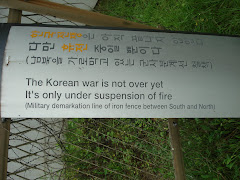
Hanging near the border with  It stands as sign of the hope and longing for the people of
Wednesday, August 13, 2008
A Home near the DMZ

"Welcome to the Society of St. Francis" the sign says.
The brothers’ prayers and welcome to men and women seeking a time and space for quiet seems all the more profound to me.  There were three guests here when I arrived. Like most of our friaries around the world, there are usually a few people around. One of the essential pieces of being a peacemaker is to carry on living with integrity and joy and affirming life, welcoming people into clean and orderly spaces, and the humane routines of shared meals, silence, prayer, laughter.
So today we shopped, ate lunch (walnut jelly and buckwheat noodles!) then went for ice cream (black sesame seed and walnut—walnuts play a big part in the local food), looked at dams, roads and lots of tunnels and other construction projects.  The brothers shared a dislike for the construction boom, pointing out the encroachment on the rice paddies, the cheap and gaudy tourist facilities. And we told stories about our lives, our hope for the
Saturday, August 9, 2008
Ecumenical Dialogue

 history of it, the way we teach new members about it, the spirituality behind it and how we can work together towards realizing even more connection between Anglican and Roman Catholic
 Our minority allows us a great freedom: freedom to try things, to change direction if we need to, freedom from always having to “get it right” and justify ourselves to a huge bureaucracy. But our freedom also has some pretty big responsibilities that come along with it: we are responsible for trying new things, imagining new ways to live, keeping our priorities on God, the Gospel and the people who come our way. And on loving each other; because we are so small it is possible to know every member of the order and to have a relationship with each brother, at least in prayer. That is
  how I understand part of my job: to know and love the brothers and sisters. Out of these relationships God will bring a new thing. We don’t need to know what it is, because if we did we might become fearful or anxious!
 It was not intentional mind you, we simply sought out the people we knew and were comfortable with. Tonight we were all mixed together and the table was loud with laughter. The dining room crew was rattling their equipment to alert us to the late hour. Church unity doesn’t seem such a far fetched idea.
Subscribe to:
Posts (Atom)